
The traditional system of nature conservation and use practised by the Baka people comprises various practices enriched by traditional know-how passed down through the generations.
In this case, the Baka of the village of Zouoba, situated in the north-west of the Republic of the Congo, practise dam fishing, honey gathering and the harvesting of wild yams.
Listen to a song sung by members of Zouoba village about the forest.
Although these practices contribute effectively to nature conservation within the meaning of the Convention on Biological Diversity (CBD), they remain largely unrecognised in national policies and legislation in the Republic of the Congo. It is also worth noting the limited involvement of the Baka people in the process of revising the Congo’s National Biodiversity Strategy and Action Plan (SPANB).
For the Congo to achieve the conservation targets set out in the global biodiversity framework, it will be necessary to forge partnerships with indigenous peoples, recognise their lands and territories, acknowledge their systems of sustainable management and seasonal harvesting of natural resources, and safeguard their roles as custodians of biodiversity and partners in its conservation, restoration and sustainable use.
Practice 1: fishing at the dam ensures sustainable harvesting and contributes to forest dynamics
Baka women practise dam fishing to meet their subsistence needs, including those of their families. Beyond meeting basic needs, it is a cultural practice whose structure ensures the sustainable use of fish stocks. A distinction is made between ordinary fishing and the practice involving edjengui.
For ordinary fishing, the women themselves choose the fish-rich areas where weirs will be erected. Men’s labour is required in cases where sturdy structures need to be erected.
At the start of the activity, a fire is lit to prepare the Baka for the kossé ritual, organised specifically to break spells, ward off bad luck and offer words of blessing to the spirits of the forest.
Next, the weir is built using mud, dead wood and leaves. Once the structure is in place, traditional and semi-modern tools are used to drain only the downstream section of the watercourse.
At the same time, the harvesting of fish, crabs and prawns begins, continuing until the average depth of the riverbed is reached. Harvesting takes place during the day, allowing for sorting. Indeed, the women systematically and meticulously select species that are fully grown and of medium size. The young fish are automatically released back into the river.
Once the harvesting is complete, half of the dam is skilfully dismantled, a unique traditional skill. The undamaged half of the dam will serve to retain organic matter and mineral salts to feed the fish. The small section of the dam that has been dismantled will allow the water from the upper reaches of the river to flow downstream. In this way, the fish stocks from upstream and downstream are mixed together.
It is also worth noting that if there is a pregnant woman in the group, she is invited first to enter the river and throw in a specific leaf, called kwaposso, a symbol of fertility.
As for fishing involving edjengui, the location is chosen by edjengui. It takes place in the same way as ordinary fishing, with the exception that the women throw different leaves into the water at the end of the catch, in accordance with the instructions of edjengui. This hunt is carried out with the aim of feeding large numbers of people following an initiation ceremony.
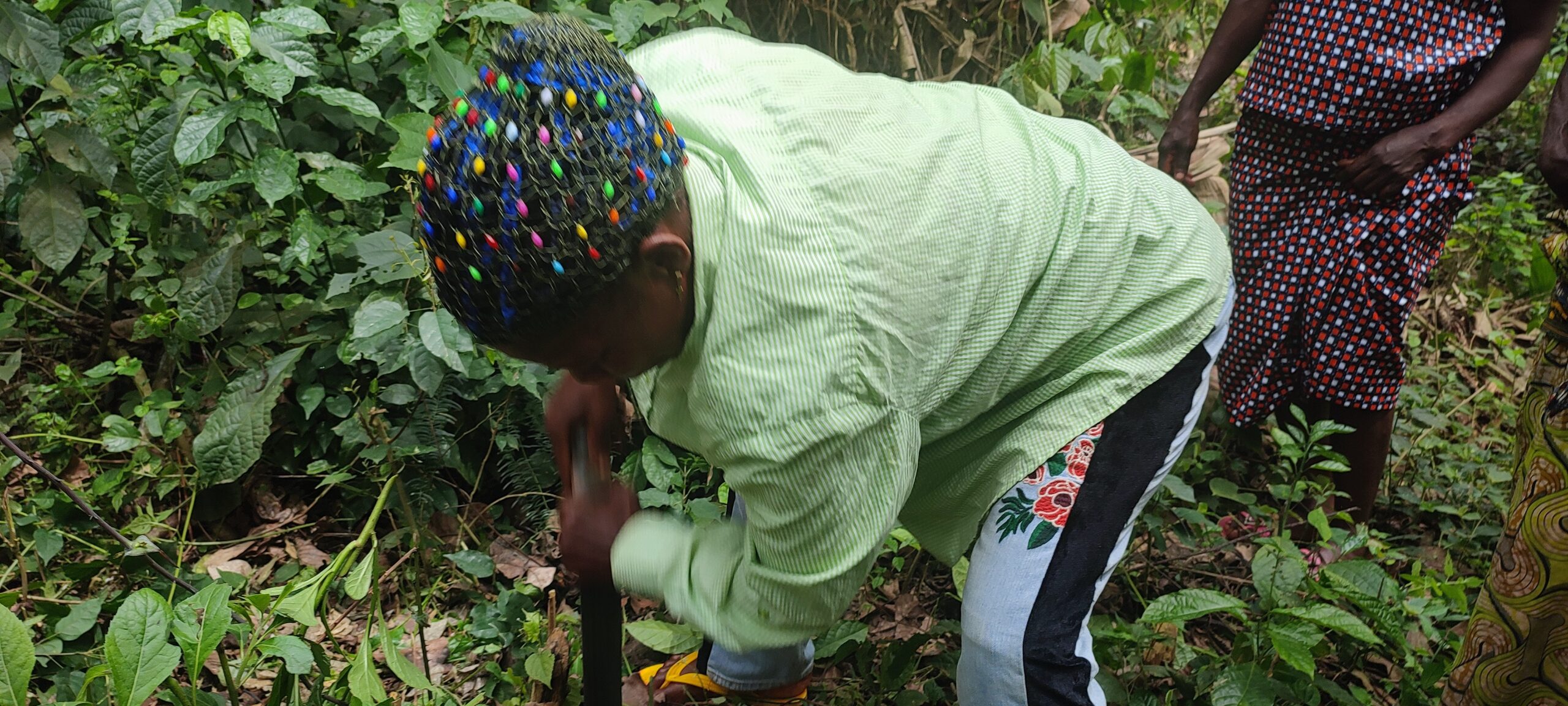
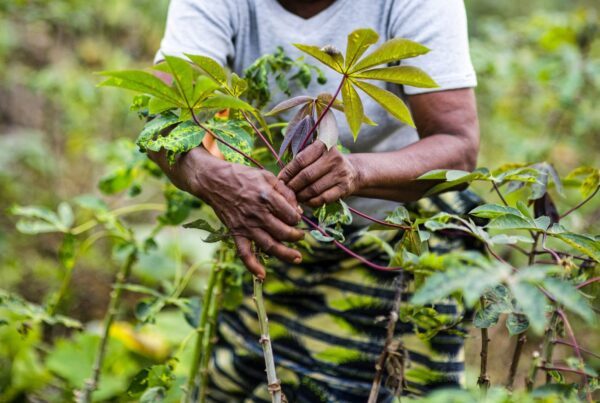
Caption: Gathering wild yams. The Baka community of Souanké, Republic of the Congo. Credit: Dalton Aweleka
Practice 2: sustainable honey harvesting helps to preserve forest resources
In Zouoba, honey gathering – known as nado foki in the Baka language – takes place between January and April. Unlike dam fishing, this is an activity specific to Baka men. These men, who possess traditional know-how passed down through the generations via initiation ceremonies, first identify the trees colonised by bees. This identification is based on the sound made by the bees, known as mangombé in the Baka language. To do this, the Baka men organise patrols to detect the sounds of bees, which differ depending on the time of day: at 4 am, the sound detected is called makélo, and libendi during the day until 3 pm. Once the tree has been identified, the Baka men can organise the kossé exorcism ceremony according to the appropriate time of year.
Once the tree has been identified, the next step is to make a rope to help climb up to the container known as a pendji, which will hold the harvested honey. Now that everything is ready, the Baka men light a fire known as yandi, made from leaves, to ward off the bees: thus begins the honey harvest.
The tree is climbed using a yenda vine by the honey harvester. As he climbs, the honey harvester carries the yandi fire, attached to the end of a stick, as well as a traditional axe. Once in front of the hive, an opening is made in its cavity to collect the honey into the pendji. Only half the honey is harvested, leaving the wax and another portion of honey to allow for the hive to be repopulated.
This sustainable and systematic harvesting, achieved through the prior identification of honey-bearing trees, contributes effectively to the long-term preservation of forest resources. In terms of sustainable management, honey harvesting is environmentally friendly.
Practice 3: gathering wild yams helps to ensure the long-term sustainability of forest resources
Both Baka men and women from the village of Zouoba gather wild yams in the forest. The women are particularly skilled at recognising edible yams. This traditional knowledge has been passed down to them through the generations.
Yam gathering is not merely intended to meet the basic needs of the Baka people. The activity also involves monitoring and supporting the regeneration of the forest. At the start of the activity, the kossé ceremony may be held. Afterwards, the women, taking the lead, identify the areas where the yams have reached maturity. The yams are then sorted: areas with lower density are enriched using forest leaves and humus. These areas are subsequently placed under surveillance as ‘food stores’ until the yams reach maturity.
As for areas with a high concentration of yams, harvesting is carried out on a rotational basis to prevent over-exploitation. Harvested areas are replanted once harvesting is complete. This is because only the edible parts of the yam – specifically the tuber – are collected. The root (the ‘head’) and the vines are replanted and buried in soil that has been turned over and enriched with organic matter, ensuring sustainable harvesting.
To ensure the forest’s sustainability, the Baka people of Zouoba have adopted several conservation measures, such as: a ban on bush fires; monitoring the forest to assess the maturity of the yams; a requirement to replant after harvesting; the designation of harvesting zones; and the introduction of a rotation system.
Yam harvesting is associated with the enzhengui ritual, which consists of a spiritual dance, the invocation of the forest spirits and an initiation into traditional knowledge. The practice of this ritual strengthens the harmony between the indigenous Baka people and nature.
It is clear that the traditional practices of the Baka people have contributed to the protection and sustainable use of biodiversity for millennia. To ensure the success of the Global Biodiversity Framework, it is essential to protect the Baka’s practices, culture and land rights.
About the author
Jérôme Ambassa: Born in Sembé (his mother’s home town), he moved to Zouoba – his father’s home village – in 2016. As an indigenous leader, he possesses a wealth of traditional knowledge passed down through numerous rituals and initiations. He plays an active role in advocacy workshops concerning decision-making that affects the land and natural resources of indigenous communities.