
“You round food with many thorns, Foster mother of the Topnaar children, Even when I’m far away, I shall think of you.” These words are from a praise of the ǂAonin, a clan from the Nama People and one of the oldest Indigenous communities of current Namibia, to the !Nara desert melon, a plant that has accompanied their life and destiny for countless generations. This case study is about this existential relationship between the ǂAonin community and the !Nara plant, how modern development has been disrupting and damaging it, and what it would take to safeguard the contribution of this relationship to more-than-human well-being in the lower Kuiseb river basin.
Read this case study in Khoekhoegowab here, and listen to it below.
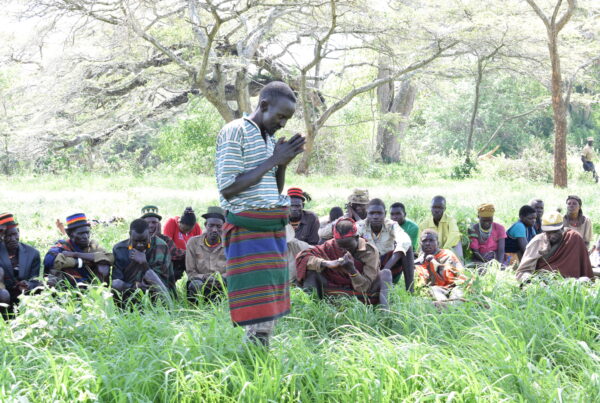
The ǂAonin (meaning “People living on the edge”, also often referred to as Topnaar) have lived in the coastal area of the Namib Desert for centuries as hunter-gatherers, fishermen and pastoralists1. In the 19th century, the largest part of the ǂAonin settled in the lower Kuiseb river basin near Walvis Bay, while a small community settled further north in Sandfontein. Today, probably about 2,000 or fewer people have ǂAonin ancestry and identify with the ǂAonin. While some of them have migrated outside of the Kuiseb valley to make a living in or near towns of the Erongo region, between 400 and 500 people remain in this area and are maintaining a lifestyle that comprises significant Indigenous elements.
A deep connection with the !Nara
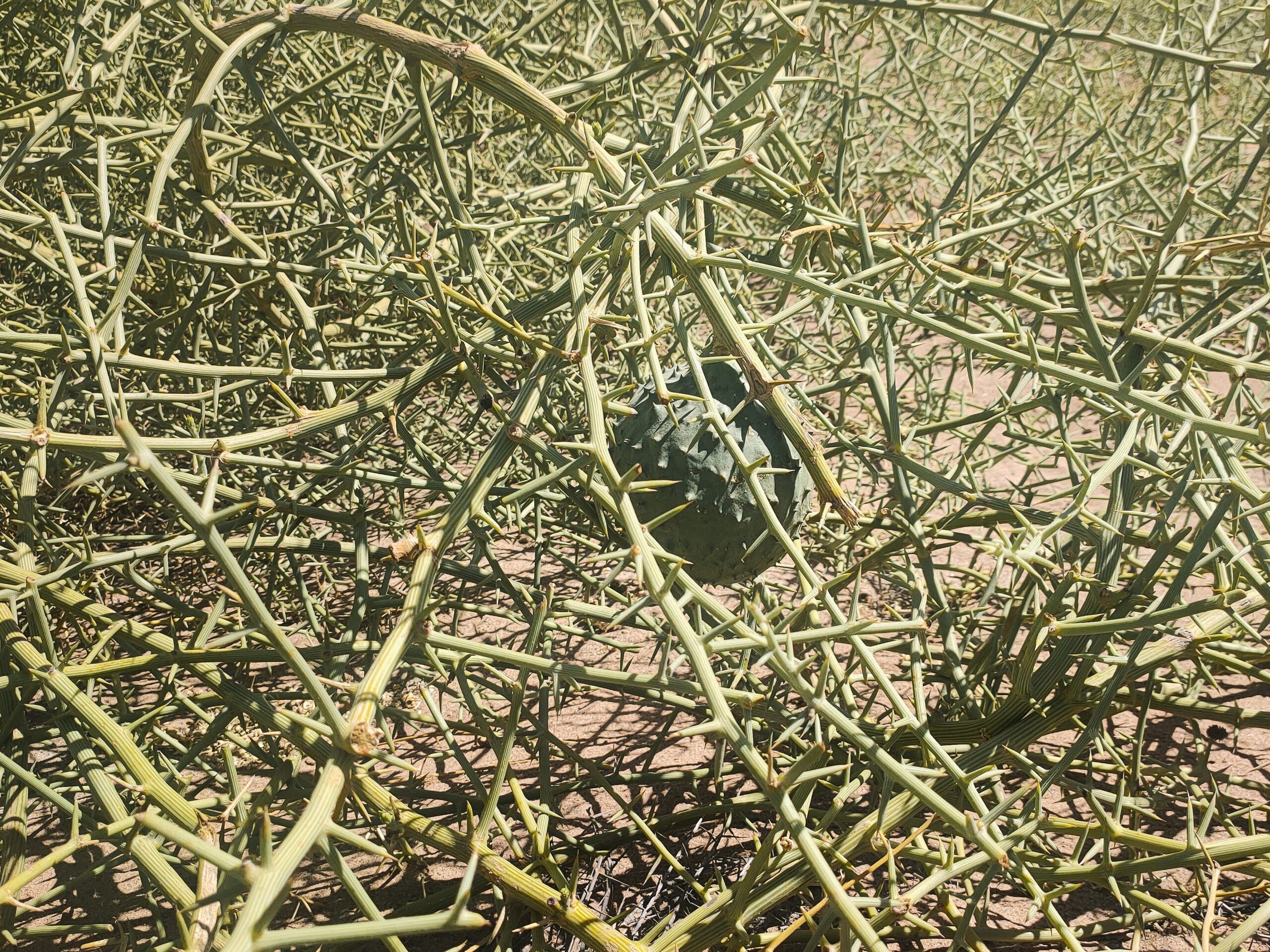
In particular, the ǂAonin heritage, identity, ways of life and livelihood are historically and presently connected to the !Nara2. !Nara, which means “plentiful”, is an endemic plant living in the arid Kuiseb river basin and adjacent dunes. Elders refer to it as a tree, because it bears melons on branches above the ground. It has a large root system integrated into its branches, with a main tap root going up to 50 metres underground to fetch water. It also has parts that function both as thorns and leaves to defend the plant and capture moisture.
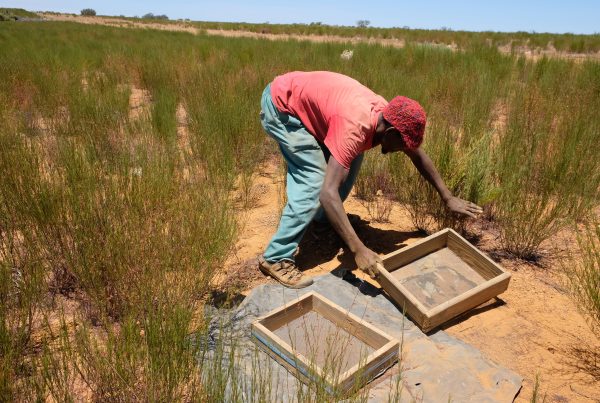
!Nara is not only a key component of the area’s more-than-human desert ecology – providing shelter, food, water, medicine and more to microorganisms, insects, birds, rodents, snakes, jackals and brown hyena (an endangered species), wild herbivores, livestock… and human beings inhabiting this land. It is also an object of Indigenous and scientific knowing, and a source of commodities (e.g., seeds for oil and food; roots for medicine) that are harvested, processed, and sold locally or to a company producing natural cosmetics.
!Nara is also a core component of the ǂAonin’s lively identity, culture, and spiritual connection to the land. References to !Nara are omnipresent in ǂAonin songs, ceremonies, and prayers, and branches and fruits of the plant itself are generally present in community meetings. Besides, some ǂAonin harvesters continue to receive melons from plants that their parents and grand-parents used to harvest, reinforcing a close sense of connection and love with these plants. As community members like to point out, “You cannot separate the ǂAonin people and the !Nara, we are one.”
“In the field, my ears, my eyes, and everything is active. What the body tells you, don’t ignore that body sign. I don’t see in my back. But when a snake comes nearer, I feel something in my body, then, I turn around and I see the snake. When the sun is high, snakes will go in the shadow of the !Nara bush. In the morning, they stay outside of the bush, and you must be careful, because the snake is waiting there. If things are not right at home, I cannot complain constantly. Then I go to the !Nara fields to find peace. The field is a very nice thing for me.”
A community elder, harvester, trader, and knowledge-holder of !Nara
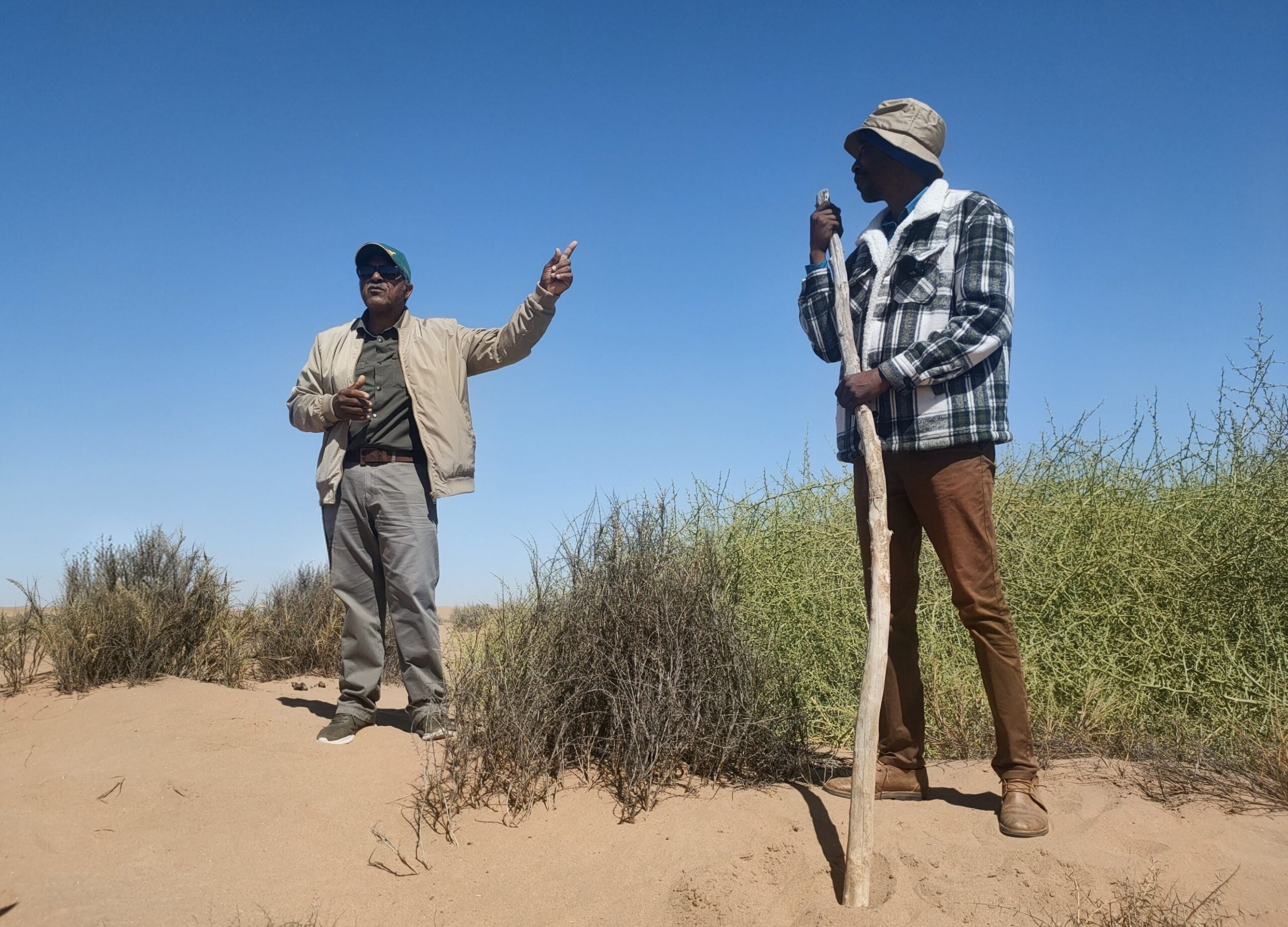
Caption: Rudolf Dausab (left) and Herman Areseb (right), two elders and knowledge-holders from the ǂAonin community. Credit: Dr. Damien Krichewsky, University of Bonn, Principal Investigator of the TEGA action research project.
Threats to the ǂAonin people and the !Nara
Since German colonial authorities integrated the Kuiseb river basin into a game reserve in 1907, it has been placed under various regimes of nature conservation, involving several attempts by the authorities to remove the ǂAonin community from the area. Each time, the ǂAonin managed to safeguard their right to stay by arguing that a forced relocation would destroy their bond with the !Nara, which is essential for the community to survive.
Today, the area falls under the Namib-Naukluft National Park, established in 1979 under South African rule, and the adjacent Dorob National Park, created in 2010 from the National West Coast Tourist Recreation Area. Living in these national parks imposes numerous constraints on the community. For instance, their activities are contained within a 2km wide strip of land running along the Kuiseb riverbed. Hunting and the collection of plants other than the !Nara are severely restricted. National park regulations also prevent traditional practices such as the selective burning of disease-affected branches of !Nara to heal plants, support their regeneration, and prevent the spreading of illness.
Moreover, in many instances, community leaders depend on the approval or intervention of state authorities to be able to sort out issues on the ground. Not only are community leaders experiencing this subordination as diminishing and wrong, but it also creates practical difficulties. For instance, if people from the community spot illegal harvesters of !Nara in a field, they do not have the authority to intervene. By the time authorities are informed and possibly intervene, the illegal harvesters are gone.
“The community sees the !Nara as its resource. And we feel so helpless at the moment, because we’ve got no control over what people are doing in the fields. Everybody depends on MEFT [Ministry of Environment, Forest and Tourism] to take action. The community cannot take action. If we go there and we stop those people that are harvesting in the !Nara field, and somebody starts to fight, what are we going to do? The police will come and they will arrest us all. Now we’ll have to go to court. For what? Because the law says you don’t have the right, only MEFT has the right. If there is someone to be arrested, it’s MEFT that needs to stop and to arrest them. But they are not there. That is why the problem is still existing.”
A community elder and activist
Illegal harvesting, which is fuelled by urban sprawl and nearby factories that draw the population closer to the !Nara fields, is a multifaceted problem. Harvesting by outsiders takes away a part of community members’ precarious livelihood. It also damages the reputation of the !Nara products, to which the reputation of the ǂAonin community is attached, because illegal harvesters usually do not know which fruits are ripe, nor how to properly extract, cook, and dry the seeds.
Outsiders also don’t know how to harvest !Nara melons carefully and respectfully, without damaging the plants – a skill that has been passed down over generations in the community. Because they generally focus on getting the highest yield for the lowest amount of work, they do things like breaking branches and cutting tranches through the thorny bushes to access the melons inside. Since they leave the tranches open, animals use them afterwards to enter the bushes, further damaging the !Nara.
!Nara plants and the more-than-human community of beings whose well-being depends on them suffer from other issues as well. For instance, according to community members, large-scale water extraction to supply urban and industrial areas has significantly lowered groundwater tables. This has impacted community members negatively, since they cannot access water freely through wells as they used to, but must buy commodified water from NamWater, a state-owned enterprise in Namibia. In some areas, the overextraction of water has also led !Nara plants to die from thirst, or to suffer from the contamination of groundwater with salt water. The decrease in wildlife is a further source of concern, because the !Nara population needs animals like jackals to eat its fruits and disperse its seeds.
Finally, changes within the community have negatively affected the integrity of its relationship with the !Nara. One is the decision under the late Chief Seth Matawa Kooitjie to replace hereditary harvesting rights of extended families in “their” !Nara fields by a system where any community member is allowed to harvest any !Nara fruit. While the previous system had become problematic and partly defunct, according to some elders, the new system of community-based ownership has led the younger generation to focus on the yield, without following traditional harvesting practices that safeguard the well-being of the !Nara ecology. According to elders, another change is the relative loss of interest of the younger generation for their community’s traditional knowledge of – and care for – the !Nara, which has lost significance in their everyday life and livelihood.
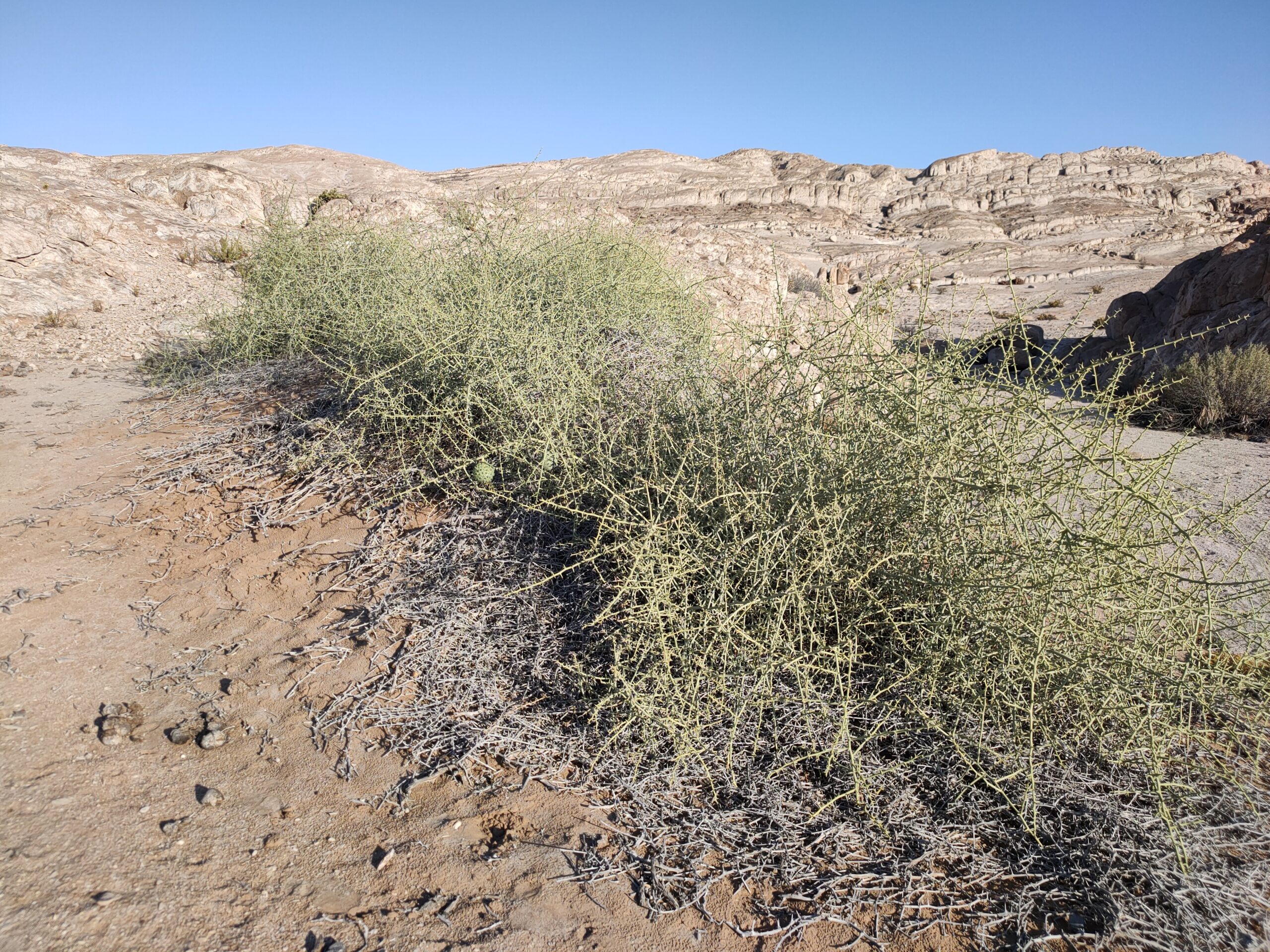
Caption: A young !Nara plant facing life under increasingly adverse conditions. Credit: Dr. Damien Krichewsky, University of Bonn, Principal Investigator of the TEGA action research project.
Community-led plans and collaborations to revive the threatened !Nara
As a result of these socio-ecological changes, over the decades, the population of the !Nara plant has significantly decreased, and the health and productivity of remaining !Nara plants have declined in many areas. Within the community, and in dialogue with others, some elders and leaders who care deeply for the !Nara have been busy thinking about how to change this trend. Building on previous work and a stranded !Nara centre project that might be revived, some ideas involve creating a cooperative to harvest, process, and trade !Nara products to generate more income for community members. Creating and operating this cooperative would go hand in hand with providing training in sustainable harvesting (informed by traditional practices), in the production of !Nara commodities, in marketing, and in the management of the cooperative. Scientific research alongside and with community members on the socio-ecological needs of the !Nara population, coupled with pre- and post-harvesting surveys, would inform a resource management plan, the enforcement of harvesting quotas, and the adoption of other measures to regenerate and safeguard the well-being of the plants.
To ground these activities not only in commercial, managerial, and scientific considerations, but also in the land and culture of the ǂAonin, for which the !Nara plants are cherished companions and an invaluable source of life in the harsh desert environment, elders and leaders also wish to support practices of chanting, praising, and expressing gratitude to the !Nara. This does not necessarily mean the static reproduction of a traditional cultural heritage that should be transmitted to younger generations. Rather, it can involve a diversity of lively cultural practices that interweave transmission and creation across generations. Ras Deon’s rasta reggae song Nara Blessing is a beautiful illustration of this cultural life.
For this positive dynamic to unfold, what is needed is not only funding, but also changes that, given present inequalities and power imbalances, are quite difficult to achieve. In particular, the ǂAonin community aspires for changes in its relationships with public authorities, commercial entities, academic actors, non-profit organisations and donors, to regain actual autonomy and receive more empowering support. Such changes cannot be unilateral. They require mediated and facilitated relational work for all parties involved to understand the intricate layers of the issues at hand, to learn to see the situations from the others’ perspectives, and to nourish relational qualities such as trust, care, and respect. Besides, these changes require political work from all sides to shift formal structures (e.g., relevant laws; park regulations; ownership rights) and transform practices that have disempowered the ǂAonin and restricted their ability to safeguard the more-than-human well-being of the lower Kuiseb river basin.