

The Wampis people are strengthening their territorial governance through projects focused on the conservation and sustainable management of biodiversity, centring on species of high ecological and cultural value.
The Wampis people in Peru, who have referred to themselves as the Wampis Nation since 2015, established their own Autonomous Territorial Government (GTANW) to lead their internal processes and strengthen the defence of their territory against present and future social, environmental and territorial threats. These threats include extractive activities and external pressures that jeopardise the integrity of their forests, rivers and communities.
With this in mind, during the first five-year period following its creation, the Wampis Nation collectively discussed the thirteen thematic areas set out in the Statute and defined corresponding policies, thereby charting its common future in various fields. As a result of this process, a central planning and guidance document known as the Common Vision for the Future (VCF) was drawn up. This document constitutes the main roadmap and strategic framework guiding the decisions of Uun lirunin (the Wampis parliament), as well as those of the authorities and communities. The VCF sets out the progressive implementation of short, medium and long-term actions aimed at rebuilding autonomy and achieving Tarimat Pujut (Good Living) for future generations.
In line with this vision, the ‘Paths to Transformation’ project has been underway in the Wampis territory since 2023, funded by the IKI (International Climate Initiative), a German government programme whose overall objective is to conserve and manage natural resources of ecological and economic importance, ensuring their sustainable use by local communities in the Santiago and Morona river basins.
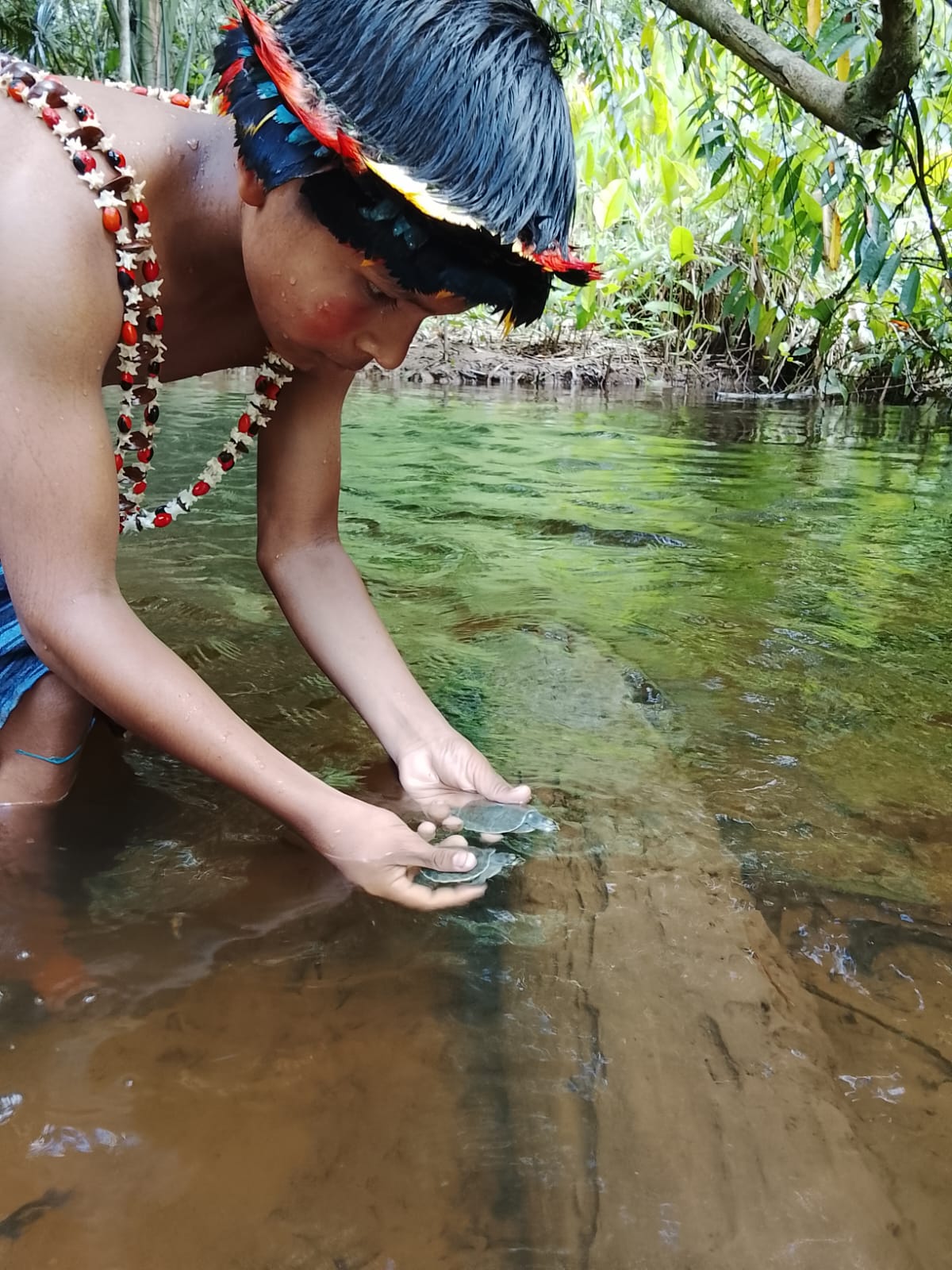
One of the key components of this project is the management and restocking of populations of the aquatic turtles Podocnemis unifilis (taricaya) and Podocnemis expansa (charapa). Both species of turtle, which are of great cultural, spiritual and dietary value to the Wampis, perform essential ecological functions in Amazonian ecosystems. However, they face threats such as habitat destruction, river pollution and the effects of climate change.
Added to this is the capture of breeding females on nesting beaches, the removal of adult and sub-adult individuals using nets and hooks, and the collection of eggs from nests. These pressures have led to a significant decline in natural populations and have altered the communities’ traditional practices, forcing them to rethink their strategies for use and conservation.
As part of the project, work is being carried out to strengthen the capacities of community members and their leaders to manage the turtles directly, as well as on environmental education initiatives that promote ownership and ongoing participation amongst schoolchildren, young people and adults. To date, work has been carried out with six riverside communities (San Juan, Puerto Juan, Sánchez Cerro, San Francisco de Chiwaza, La Libertad and Ayambis) and 136 community members, with three hatchling release campaigns having been organised since the project began. The results demonstrate successful management, with a hatching rate of 69.8 per cent for taricayas and 55.56 per cent for Charapas.
The release of more than 10,000 live taricaya cubs and more than 1,500 live charapa cubs over the three years the project has been running represents a significant contribution to the recovery of the natural populations of both species.
“The charap (taricaya) have always been found in Wampis territory, but we are now seeing their numbers decline, and this worries us, because their disappearance would leave a void in nature. That is why we have started to work on their recovery, and in my community it is the women who are leading this effort. We feel that people are becoming aware of their ecological importance, and we know that, for now, we must focus on protecting them and ensuring their recovery, so that in the future they can survive without becoming extinct.”
Marixa Kukush Pati, Wampis leader of the Shinguito Community, Morona district, in the province of Datem del Marañón, department of Loreto, Peru. She has been leading the management and restocking of aquatic chelonian populations in her community since 2023
Another initiative currently being developed is the management of Arapaima gigas (paiche), recognised as the freshwater fish with the largest scales in the world and an iconic species of the Amazon. Its primary ecological role is that of a piscivorous predator; it also acts as an indicator of the health of aquatic ecosystems and constitutes an essential source of protein for local communities. However, historical overfishing has critically reduced its natural populations.
In response, a programme to reintroduce the species has been launched at Cocha Shinguito, in the community of Puerto Juan within the Morona catchment area, as a strategy to restore the ecological balance and boost the local economy. In 2023, prior to implementing recovery measures, a population census was carried out in the Shinguito Lake System, using the ‘Census by Surfacing in Plots’ method. This procedure is based on a physiological characteristic of the paiche: its need to breathe atmospheric oxygen and periodically rise to the surface, an action known as ‘surfacing’.
Since 2024, the species has been in the process of recovery thanks to community management measures, including compliance with internal regulations, management agreements, control and surveillance of the area, regulation of fishing, and the protection of spawning and growth zones. Furthermore, regulations have been established for the sustainable use of the resource, including temporary fishing restrictions, adherence to minimum catch sizes and, where applicable, catch quotas agreed with the competent authorities.
These actions have reduced the pressure on the paiche population and facilitated its recovery. Monitoring carried out in 2024 recorded 236 individuals in Cocha Shinguito (141 juveniles and 95 adults), representing an increase compared with the 2023 census, when 81 individuals were counted (24 juveniles and 57 adults).
In conclusion, although the Wampis still have a long way to go, the progress made reflects an encouraging process towards the adaptation and recovery of the species, as well as towards the consolidation of a system of community-led self-development. The measures implemented have helped to strengthen local governance, reduce pressures on biodiversity and lay the foundations for sustainable management that combines ecological conservation with food sovereignty and economic development.