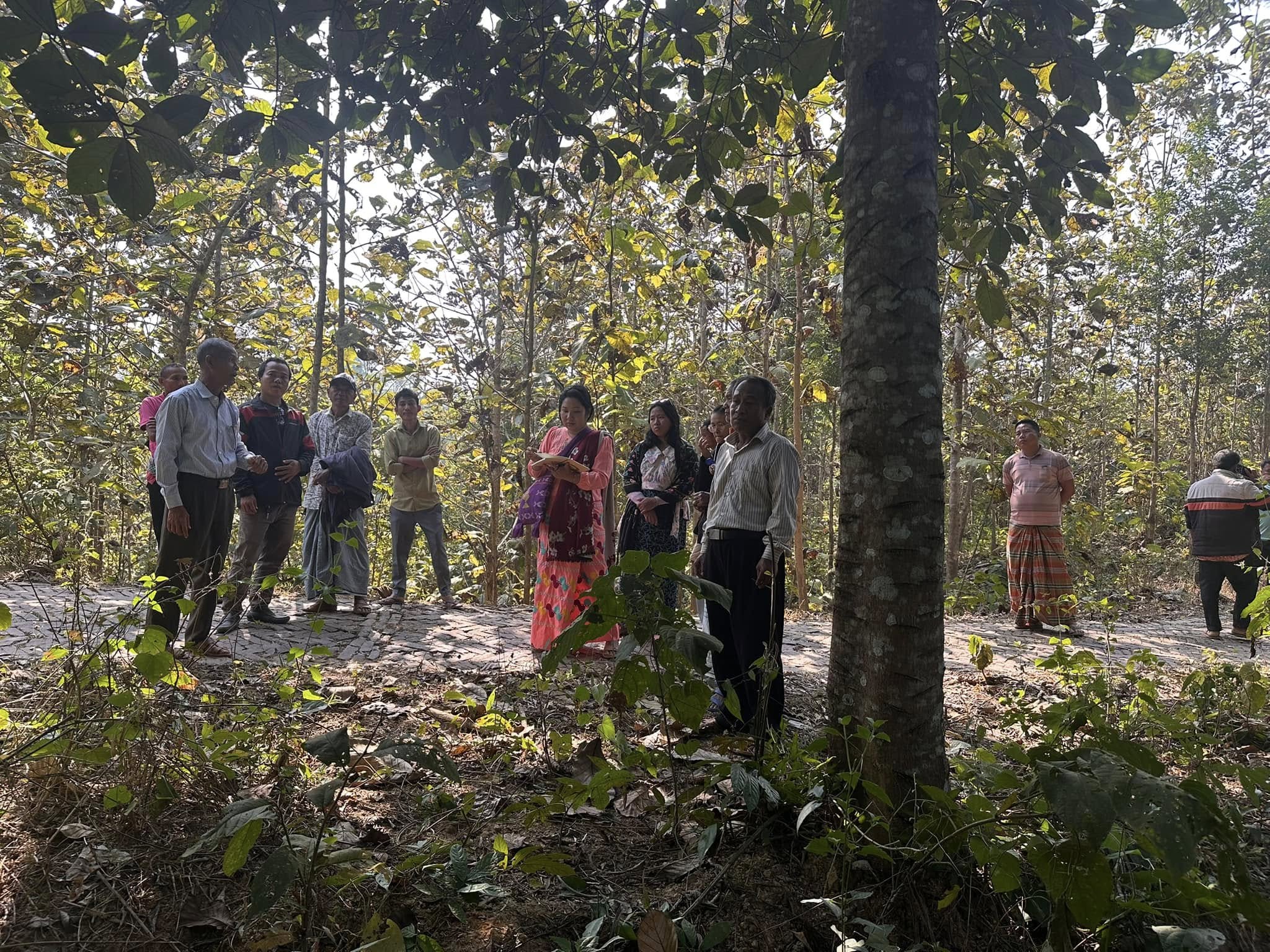

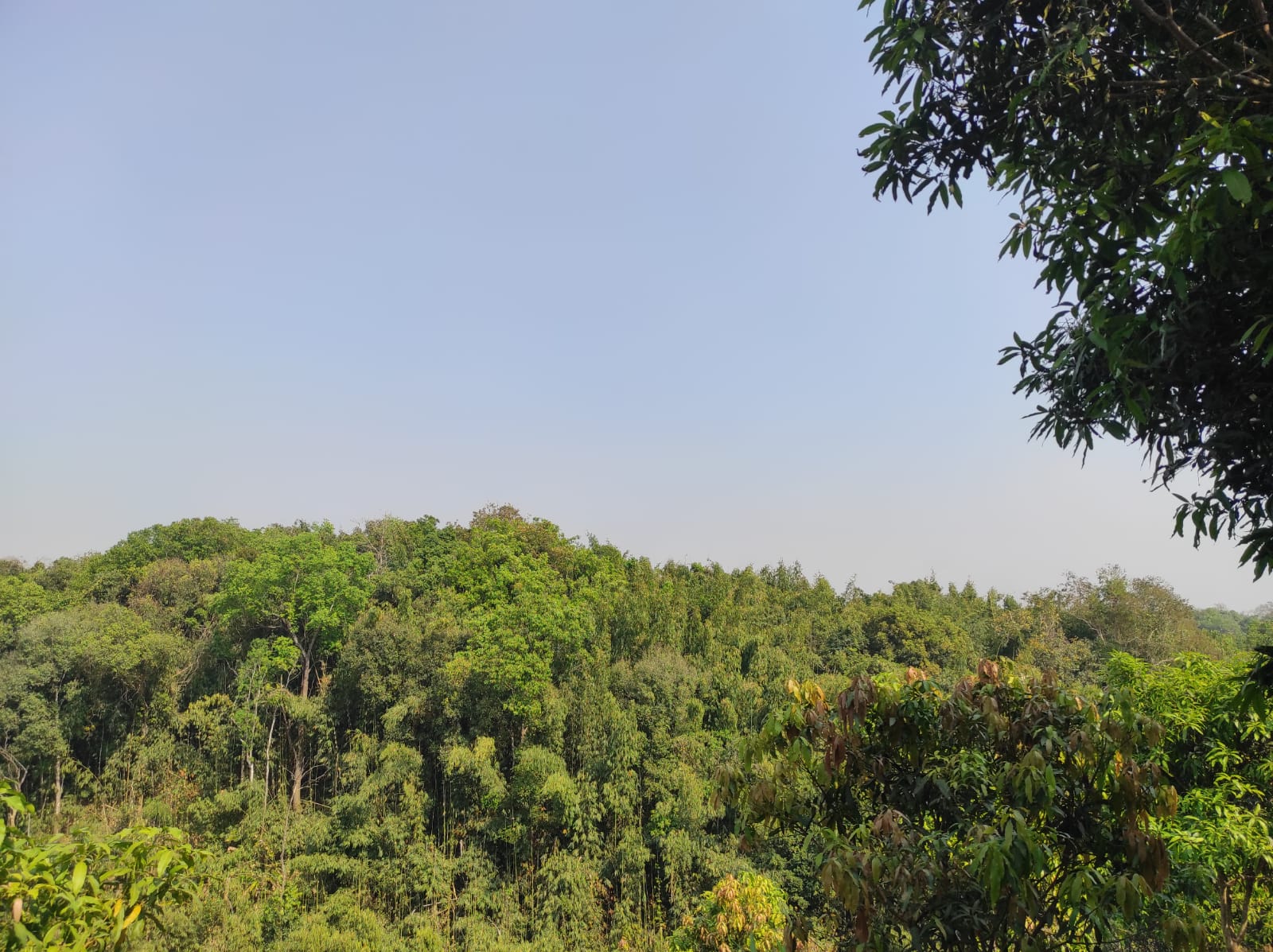
Indigenous groups in Bangladesh are combatting deforestation with a community-led forest management system called ‘Village Common Forests’ (VCFs): natural forests around their communities that they manage sustainably, instinctively supporting the implementation of the Kunming-Montreal Global Biodiversity Framework (KMGBF).
With just 12.8% forest cover, Bangladesh is forest-poor. High deforestation rates compound this issue, with a 13% decrease in tree cover between 2001 and 20242. Ninety-four percent of this loss occurred in the Chittagong Hill Tracts (CHT), which is an extensive hilly area home to more than 11 distinct Indigenous groups.
After independence, 80% of Bangladesh’s forest land was declared as ‘reserved forest’ – government-managed forests where Indigenous People are denied any rights. Residual forests were labelled ‘unclassed state forests,’ which Indigenous communities have communally managed as VCFs.
Village Common Forests (VCFs)
The VCFs are an important source of water, food, and livelihood for the local Indigenous communities in CHT, while also shaping the culture and tradition of nearby communities.
VCFs are run by committees elected by the Indigenous community, with collective rulemaking to safeguard the forest and its resources. For example, there are various financial penalties for harvesting forest resources such as bamboo, fish or animals without permission, as well as selling these commercially unless the community benefits from the money, in accordance with the fair sharing of benefits section of Goal C of the KMGBF.
In line with the Indigenous belief that a spiritual entity guards natural resources, VCF regulations seek to minimise exploitation and promote biodiversity. One resident explained that they won’t “collect even a single leaf” or hunt in the VCF area without the approval of the VCF committee for the use of these resources. Studies have shown that VCFs are more biodiverse than nearby government-managed forests, showing their contribution to Goal A of the KMGBF by safeguarding genetic diversity.
However, these Indigenous practices are at risk due to increasing external pressures. Encouraged by government schemes, there are a growing number of non-Indigenous People who are settling in the VCFs, causing population growth and increased demand on resources.
Protecting water sources
The CHTs are facing an “acute water crisis,” threatening the biodiversity and health of the VCFs. Fifty percent of the CHT population are unable to access water, making conservation more difficult.
VCFs are often chosen for protection because of their natural water sources, which Indigenous practices then safeguard. For example, in the Khande VCF, rules do not allow people to remove rocks near the water springs, as they act as natural water filters. Jhum (slash and burn) farming is also banned as this dries up water sources.
However, external land mismanagement has caused water scarcity in some VCFs. In the Betchori and Dholochori VCFs, residents reported that large teak (Segun) tree plantations on the VCF boundaries have dried up water sources.
The Indigenous community in Kamalchori, Khagrachari recognised that afforestation could restore their water source. By planting native species, they mitigated water insecurity, helped by a $10,000 donation, highlighting the importance of directly investing in Indigenous solutions. Contrastingly, NGOs gave the Rangamati VCF we visited technology to help improve water flow, but, with diminishing water in the creeks, this technology will soon become redundant.
Where Indigenous knowledge is supported, the water table can remain undisturbed and water sources continue. This shows the importance of direct funding for Indigenous communities whose knowledge and cultural practices are already supporting the conservation and sustainable use of biodiversity.
Protecting medicinal plants and cultural knowledge
VCFs are home to medicinal plants such as Haritaki, Bohera, and Amloki, which local doctors use. This knowledge is passed down along generations within Indigenous communities. By protecting these plants, VCFs protect Indigenous practices.
Similarly, safeguarding VCFs from private ownership protects the custom of safeguarding natural resources, rather than owning them. This protection and sharing of knowledge is directly aligned with Goal C of the KMGBF. Our field-level research also found an under-researched benefit of VCFs: community harmony. In a VCF in Kamalchhori, the Marma community shared stewardship by dividing the forest land and generously allocated half of the VCF area to the Tripura community. This arrangement supported community cohesion while enabling both communities to equally benefit from the VCF resources.
Indigenous access to VCFs is insecure, with little protective legislation against expanding settlements. Despite the Chittagong Hill Tracts Peace Accord of 1997, land grabbing continues. With limited legal protection to safeguard resources, medicinal plants are declining, threatening health provisions as well as generational knowledge. Residents also reported that while monkeys, deer, and birds still thrive, there has been a decline in elephants, tigers, and bears. Settler expansion and a lack of formal land titles could also threaten peace between Indigenous groups who have negotiated peaceful co-existence.
How to support biodiversity in the VCFs
The research reveals a consistent pattern – when Indigenous communities have control over VCFs, forests thrive, water flows, biodiversity blooms, and cultural identity is preserved.
The lack of legal land rights limits the success of VCFs as settler encroachment and exploitation continues. Instead of adapting to problems caused by population growth, it is more sustainable to mitigate the expansion of settlements. However, government agencies are encouraging this population growth while providing little to no funding to ensure the sustainability of the region. High unemployment rates coupled with limited alternative income opportunities has also pushed new arrivals in the VCFs to extract resources. This has led to thefts by settlers – in Betchori VCF, settlers felled two ancient trees in one night.
Although NGO projects can provide assistance, without proper collaboration with communities, they struggle to accurately respond to the realities on the ground. A report from Rights and Resources Initiative found that external actors (such as local governments, NGOs and other private actors) were 10 times more likely than Indigenous-led initiatives to produce negative outcomes.
This doesn’t mean that NGOs cannot provide value for communities, however. Direct investment to Indigenous communities is most effective, but NGOs still have a role to play. The research found that diversifying livelihoods beyond agriculture can help reduce the trade-off between conservation and economic opportunity. NGOs can provide training in alternative incomes, serving as technical partners, rather than intermediaries to reduce pressure on VCF resources.
As the climate continues to change, water and resource scarcity grow, especially in the CHT. Indigenous communities have the knowledge to adapt to or mitigate these risks, but not always the opportunities or tools. VCFs represent Indigenous contributions to environmental sustainability, Indigenous rights, and climate resilience, while contributing to the achievement of Goals A, B, and C from the KMGBF. Yet, settlements threaten the VCF framework designed to preserve the forest and its resources, while economic hardship forces some communities to break the framework. A lack of formal land recognition leaves communities without legal safeguards. Indigenous communities have generational knowledge and understand the needs of both the land and local people better than anyone else.
When Indigenous communities lead, forests thrive, but they need support. It is time to start trusting Indigenous communities as stewards of their ancestral lands and investing in VCFs as proven sustainable forest management frameworks. Indigenous communities deserve direct investment, legal land recognition, and diverse livelihood opportunities.