

Keystone Foundation is an organisation which has been working in the eco-development domain in the Nilgiri Biosphere Reserve (NBR). The NBR was the first declared biosphere reserve of India under UNESCO’s ‘Man and the Biosphere Programme’ in 1986 for its diversity of both nature and people.
In such a unique landscape, Keystone Foundation has been working for the past 32 years for the wellbeing of Biodiversity and People. Through some of its initiatives, the organisation is actively restoring degraded ecosystems alongside Particularly Vulnerable Tribal Groups (PVTGs), directly contributing to Targets 2, 22 and 23 of the Kunming-Montreal Global Biodiversity Framework on inclusive, equitable, and gender-responsive biodiversity action.
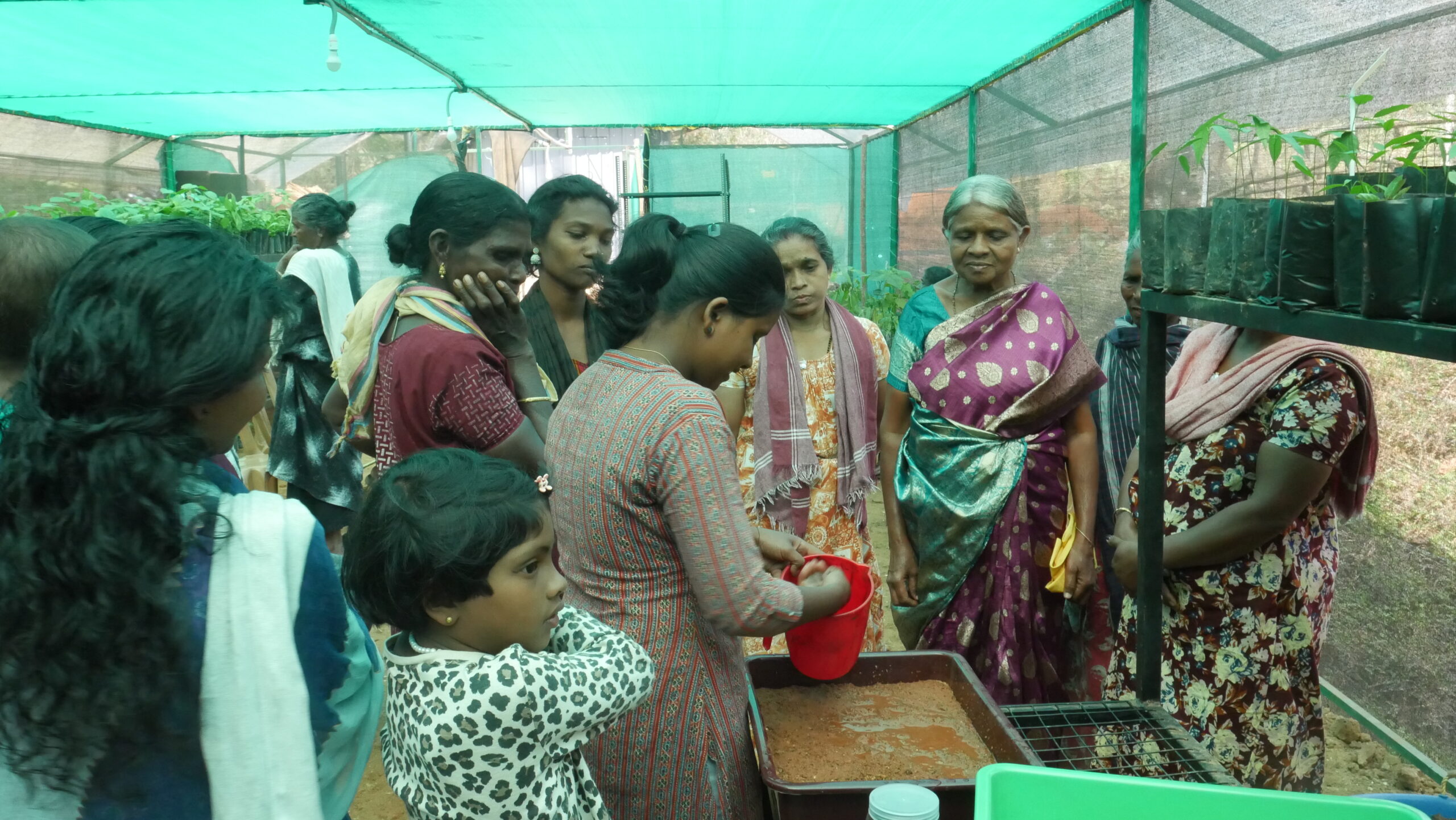
This work is approached by holding consultation meetings with the community, selecting members from the community as ‘Barefoot Ecologists’, co-designing restoration and monitoring plans with the community, and implementing the plan with the community.
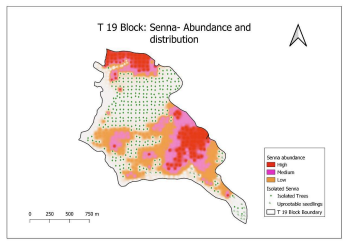
Image: Abundance of invasive Senna spectabilis in the Tholpetty range. Credit: Vinayan P A, staff at Keystone Foundation
Community experiences of ecosystem restoration
One such community-based restoration project is underway in the Tholpetty range of the Wayanad Wildlife Sanctuary covering 204 hectares of forest land. Indigenous Peoples like the Bettakuruma, Kattunayaka and Paniya play a major role as key stakeholders in the initiative. The vegetation cover includes naturally occurring moist deciduous forests, teak and eucalyptus monocrop plantations planted by the Forest Department to diversify the income of the state, as well as varying densities of invasive plants. The primary focus is to increase the native biodiversity in areas where the density of invasive plants is high.
The main invasive plants in this region are Senna spectabilis, Lantana camara and Chromoleana odorata, which are native to the tropics of the Americas. They grow and spread rapidly, overpowering native plants and disrupting the natural balance of the Nilgiri’s unique ecosystems, while also being extremely difficult to remove. In our consultations with the communities, we have learnt that the increase in these invasive plants has also reduced the availability of wild edible plants and increased the conflict with wildlife.
Case study by Renju K R, Bettakuruma: managing invasive species
Working as a barefoot ecologist in my ancestral land in the Tholpetty range has strengthened my ecological connection with the forest. The forest is an important part of our daily life a place where we collect firewood, bamboo shoots, honey, mushrooms, and other resources for our livelihood, while also living alongside countless trees, birds, and wildlife.
My community, the Bettakuruma, understands that everything is interconnected – the soil, air, water, rain, native species, wildlife movements, and the overall ecological balance are all part of one living system. My work as a barefoot ecologist has trained me to combine the traditional ecological knowledge of my community with scientific observation and field documentation – I walk the forest not just as a member of my community, but as a guardian. I observe, record, learn, and contribute to restoration efforts on the ground.
In areas overgrown with invasive species like Senna spectabilis, I have witnessed how it suppresses native growth and disturbs wildlife movements through the forest. Through restoration efforts like selective removal of invasive plants, encouraging natural regeneration, and supporting native species – I hope that the forests will get back to their original ecological character.
Our intention is not just to clear invasive species, but to recreate a healthy, diverse forest that supports both biodiversity and our community’s future. Access to resources that we have depended on for generations had been significantly hampered by the prevalence of these invasive species; before management, areas taken over by Senna spectabilis, Lantana camara, and Chromolaena odorata were extremely dense and difficult to access. The thick growth covered forest paths, making it hard for us to enter the forest, to see potentially dangerous animals like elephants and predator big cats. Moreover, the abundance of mushrooms, tubers, and other livelihood materials declined, and in some areas, human–animal conflict increased because the overgrown shrubs led to changes in wildlife movement and corridors.
With ongoing removal and restoration efforts – particularly in restoration sites within the Tholpetty range (while other sites are yet to be confirmed) – I have observed positive changes. Native seedlings are regenerating; better light is reaching the forest floor; and grasses and understorey plant diversity are returning. These signs indicate that the ecosystem is gradually recovering and moving toward a healthier, more balanced forest condition.
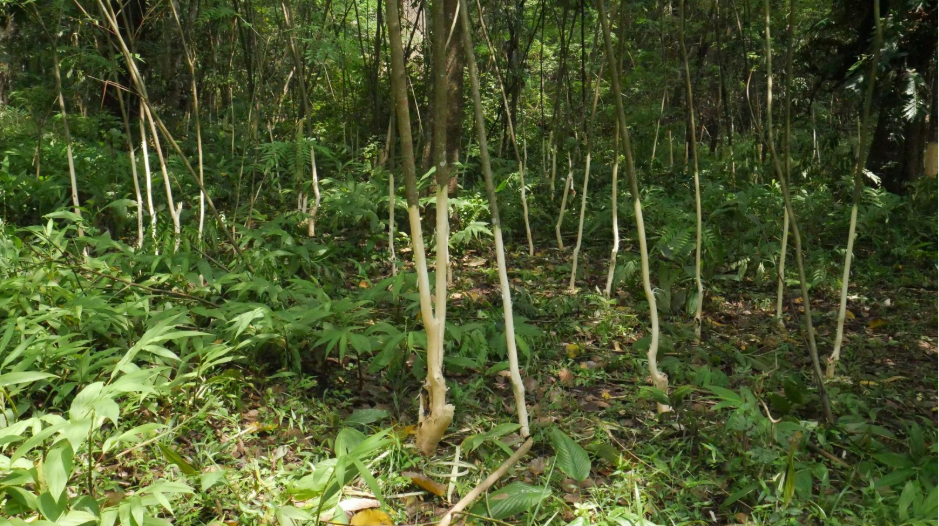
Image: Regeneration of native species on the forest floor after removal of invasive Senna spectabilis. Credit: Vishnu N M
Balancing traditional knowledge with scientific techniques
In my work as a barefoot ecologist, traditional ecological knowledge plays a vital role in understanding the forest. Elders from my community have helped identify seasonal patterns, ecological history, wildlife behaviour, and the locations of native species, including important trees and tubers that are critical to our livelihood and culture. Their knowledge provides deep insight into how the forest functioned in the past and which species truly belong to the landscape.
At the same time, scientific tools such as mobile mapping help us systematically record, analyse, and present this information. During restoration work planning and interventions, we used mapping tools to document sites accurately, and I have also assisted the wildlife monitoring team in placing acoustic recorders to help document bird diversity in our restoration areas.
The Barefoot Ecologists programme has enabled me to become an articulate communicator of the challenges my community faces with invasive species, restoration, and biodiversity. It has also taught me how to achieve conservation goals while respecting the needs of my community in scientific landscape management planning.
The programme has also increased my confidence in speaking, documenting, and explaining ecological issues in our area. This enables me to disseminate information not only to my community but to my Kattunayaka and Paniya neighbours. By sharing knowledge and working together, I see myself growing into a conservation activist who represents both community wisdom and ecological science, contributing meaningfully to the protection and restoration of our ancestral landscape.