
Like Indigenous Peoples, rural communities also possess traditional knowledge associated with their territory, such as the use of medicinal plants with health and beauty benefits, or techniques for soil and water conservation that have been passed down from generation to generation.
Mujeres y Ambiente is a small organisation legally incorporated as a Rural Production Cooperative, based in the community of La Carbonera, in the municipality of Querétaro, Mexico. It carries out activities in the primary sector (production of vegetables, rabbits, free-range hens and sheep), the secondary sector (manufacture and sale of cosmetics and personal care products made from medicinal plants native to the region) and the tertiary sector (tourism and educational services through guided tours of its facilities).
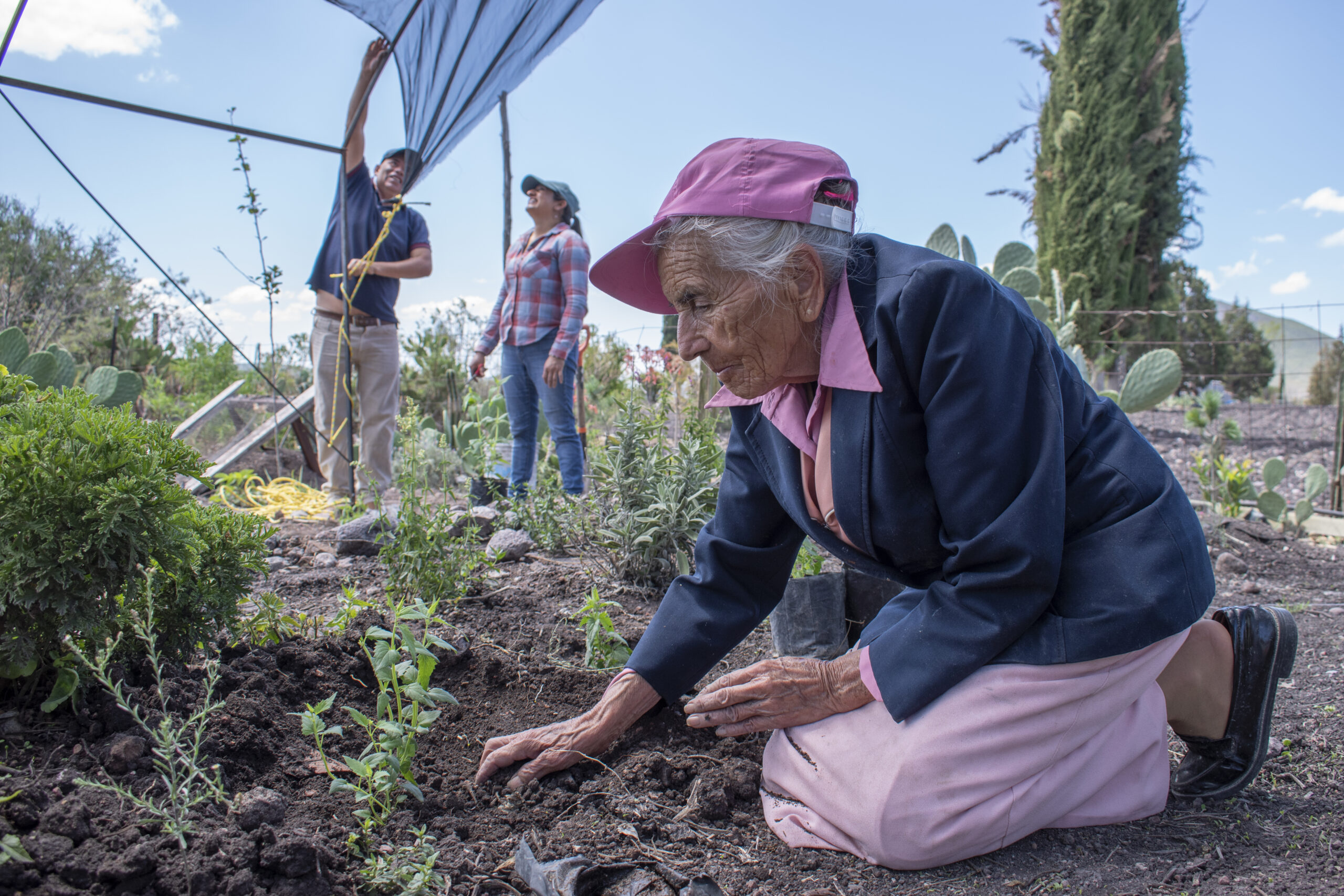
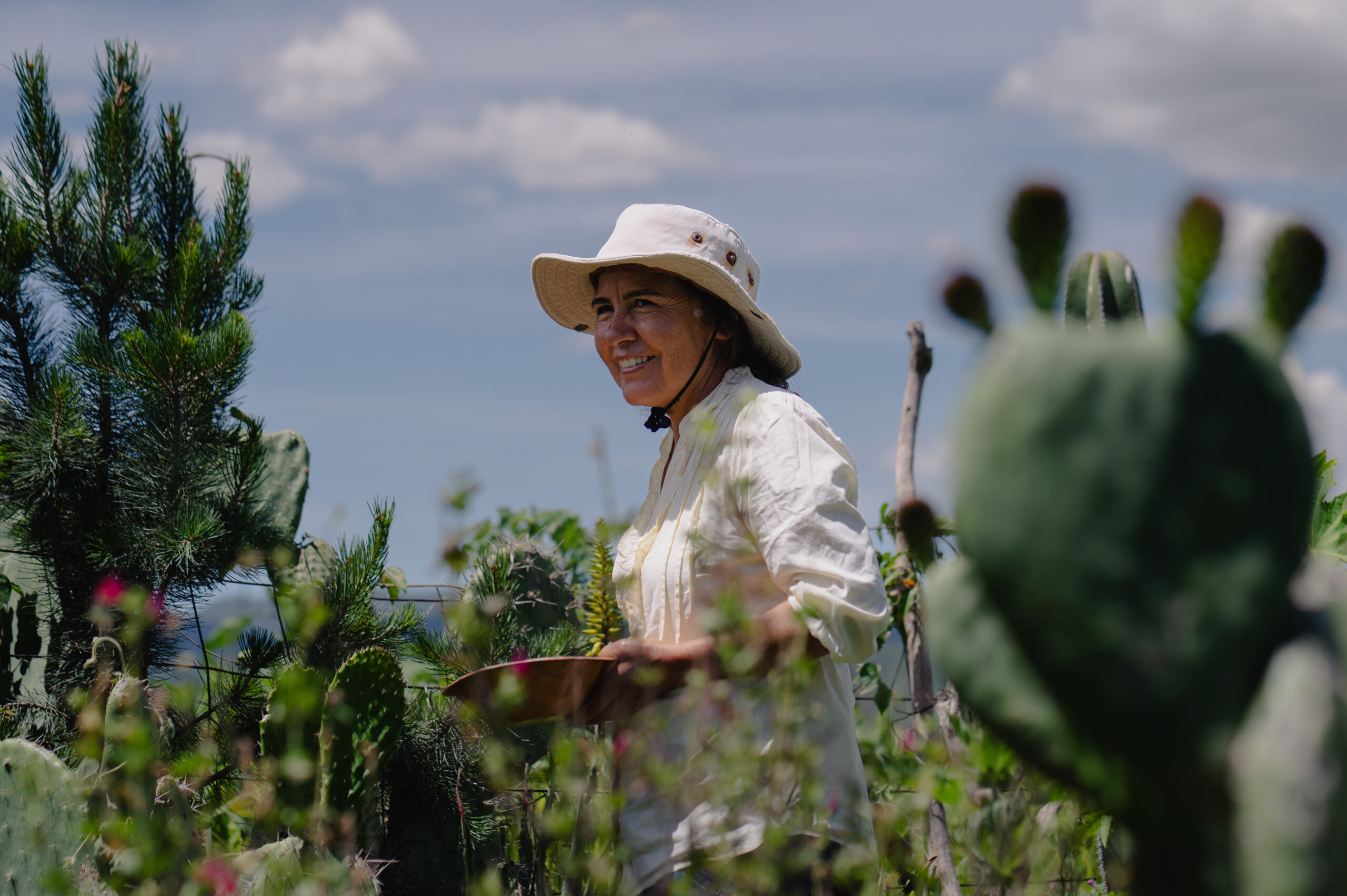
Caption: Sembrando un legado. Eulalia Moreno trasplantando toronjil (Agastache mexicana). La Carbonera, Querétaro. México. Credit: Salomón Aguilar Hernández
The creation of Women and the Environment: family, community and traditional knowledge
The knowledge that ‘Mujeres y Ambiente’ possesses regarding the use of plants and land management is inherited knowledge, which has been supplemented by technical expertise acquired through training. Six of its eight members are family members and natives of this community, which is a peri-urban community with a high rate of migration. Within the community, women play an important role as they are the ones who take charge of running the households and who guide the activities carried out in their area.
The work of Mujeres y Ambiente began over 70 years ago, when Doña Eulalia Moreno, together with her husband Faustino Balderas, began working on their plot of land – the site now occupied by Mujeres y Ambiente. They built terraces to conserve soil and water, and also constructed a small pond to collect and store water. This pond supplied this vital resource not only to their own family, but also to families in the community and neighbouring communities, in an area where drinking water only became available just over 40 years ago.
They also explain that the use of medicinal plants has always been part of the family’s tradition, both for treating illnesses and for addressing skin and hair conditions. They use plants native to the region, such as arnica, sangregado, espinosilla and lemon balm, supplemented by others that are not strictly native, such as rosemary, spearmint and aloe vera, amongst others.
This knowledge and the love instilled in them for their local area were what initially led, in 2009, to the formation of a group comprising 35 women and two men of various ages who were keen to improve conditions in their homes and ensure their basic livelihood needs were met through saving firewood, promoting women’s health and establishing family vegetable gardens using vermicomposting. Subsequently, having established a shared vision and working methods, they focused on structuring and consolidating micro-businesses through ongoing training, utilising surpluses from the production and consumption of their own food, improving the environmental performance of their homes, and raising their community’s profile in the peri-urban area, with the group splitting into various family-run or individual enterprises.
In 2016, the group – comprising mainly members of the Balderas Moreno family – decided to formally incorporate as a Rural Production Company, moving on to develop other projects, such as the use of aromatic and medicinal plants for the manufacture of cosmetics and personal care products. In addition, they developed a value chain for the marketing of dried plants used as raw materials for the cosmetics industry, in collaboration with the Spanish company Provital, which specialises in the development of extracts and active ingredients for cosmetics.
Training and partnerships
Training and partnerships with the academic and private sectors, as well as support from non-governmental organisations and state government departments, have been fundamental to the development and growth of these activities.
In 2017, together with other producers, Mujeres y Ambiente signed an agreement on access to and commercialisation of genetic resources under the Nagoya Protocol for the cosmetics industry. For this process, Mujeres y Ambiente decided to work in partnership with a group of producers from two neighbouring communities, as water scarcity on its own land meant it lacked the capacity to meet the required production levels. This particular group of producers had also previously received training in the production of native plants from the Regional Training Centre for Watersheds and the Master’s degree programme in Integrated Watershed Management at the Autonomous University of Querétaro, and as such they share common goals and commitments to local development through the sustainable use of their resources, as well as working on the conservation and restoration of their land, which, in the case of these producers, suffers from a high rate of erosion.
The Autonomous University of Querétaro played an important role in this project, as it trained producers in the propagation and cultivation of arnica (Heterotheca inuloides), a species traditionally used as an anti-inflammatory that grows in the region and is one of the species used by Mujeres y Ambiente to produce therapeutic gels and ointments. As part of this project, a Master’s student carried out a sustainability assessment of the various agrosystems developed in collaboration with arnica producers. The sustainability assessment highlights both the environmental benefits of arnica cultivation and its importance for soil conservation. For example, arnica plants attract pollinators, and the roots of the plants cultivated within these agrosystems help to stabilise the soil – a crucial factor given that, as mentioned earlier, the farming communities face erosion problems and, on some plots, gully formation could even be observed.
This environmental assessment also included an awareness-raising campaign designed to help farmers understand why it was necessary and to learn some fundamental techniques for promoting soil health. Farmers are now implementing measures within their farming systems to prevent soil erosion, such as windbreaks made from bottles and branches, as well as producing bio-inputs to fertilise their soil. It is clear that this awareness-raising and training work, stemming from the non-economic benefits of the agreement under the Nagoya Protocol, was a success, as, in interviews conducted as part of the project’s sustainability assessment study, farmers expressed concern about soil conditions and the importance of soil conservation to them (Torres-Poot, C., 2024). It is worth noting that, in this process, the experience and knowledge that Mujeres y Ambiente provided to the producers through the exchange of experiences served as a foundation for the producers to learn about the cultivation, processing and marketing of arnica.
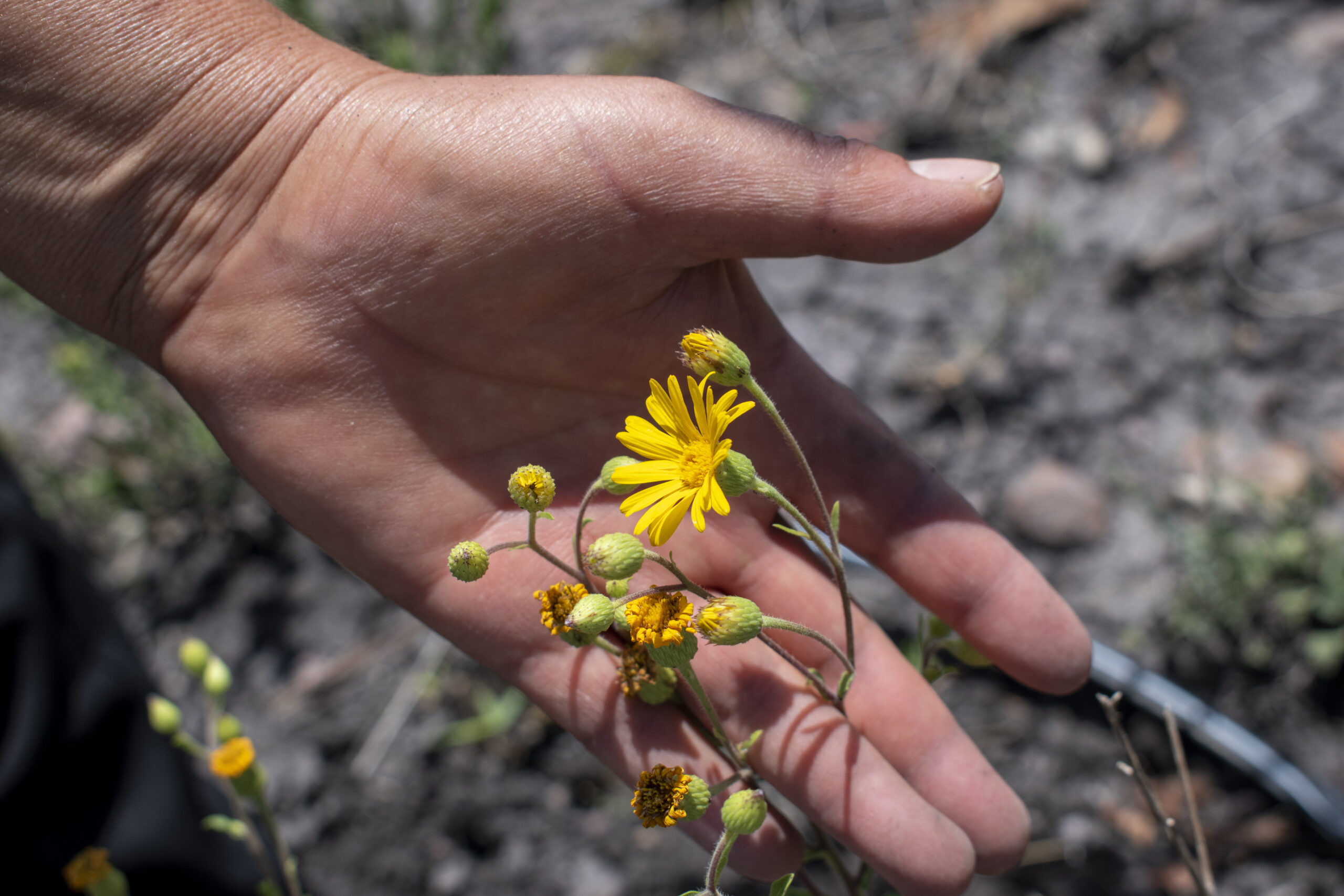
Caption: Flor de Árnica mexicana (Heterotheca inuloides). La Carbonera, Querétaro, México. Credit: Salomón Aguilar Hernández
Workshops and international visibility
Partnerships with the academic and private sectors have enabled them to raise the profile of the project on an international scale. In 2020, they were awarded the Equator Prize, an international award that recognises community and indigenous efforts to protect biodiversity and reduce poverty through sustainable, nature-based solutions.
Furthermore, in 2021, the partnership and working model with the academic and private sectors caught the attention of the organisers of Expo Dubai 2020, and as a result, in collaboration with these stakeholders, they were invited to take part in the conference: ‘Local nature-based solutions and livelihoods. Beyond trees: how to build a working ecosystem’.
By demonstrating the sustainability of its facilities, the centre has supported the UMDI – Faculty of Sciences, UNAM – in organising fieldwork, the International Workshop on Soil Classification and the International Workshop on Soil Quality Indicators.
Co-designing the space to improve production
Furthermore, through research co-funded by these same academic institutions, as well as by international funds such as the Daughters for Earth programme, it has been possible to evaluate and improve the milpa system (maize, squash and beans) by using different fertiliser treatments and assessing technology packages for the sustainable production of milpa, as well as supporting arnica growers with materials to improve their gardens and carry out soil analyses.
Work is currently underway on the co-design of the ‘Mujeres y Ambiente’ cultivation area through hydrological management of the land, with a view to improving yields from both the milpa system and the cultivation of aromatic and medicinal plants. This approach not only helps to conserve the soil, water and biodiversity of the surrounding environment, but also contributes to the preservation of traditional knowledge associated with these plants.
For example, the initial findings from this co-design process show that the terraces built over 70 years ago were constructed with almost exact precision in line with the contour lines, which has prevented further erosion of the surrounding area. These collaborations have enabled Mujeres y Ambiente to combine their traditional knowledge with new techniques to improve crop yields, grow their organisation and contribute to the local economy.
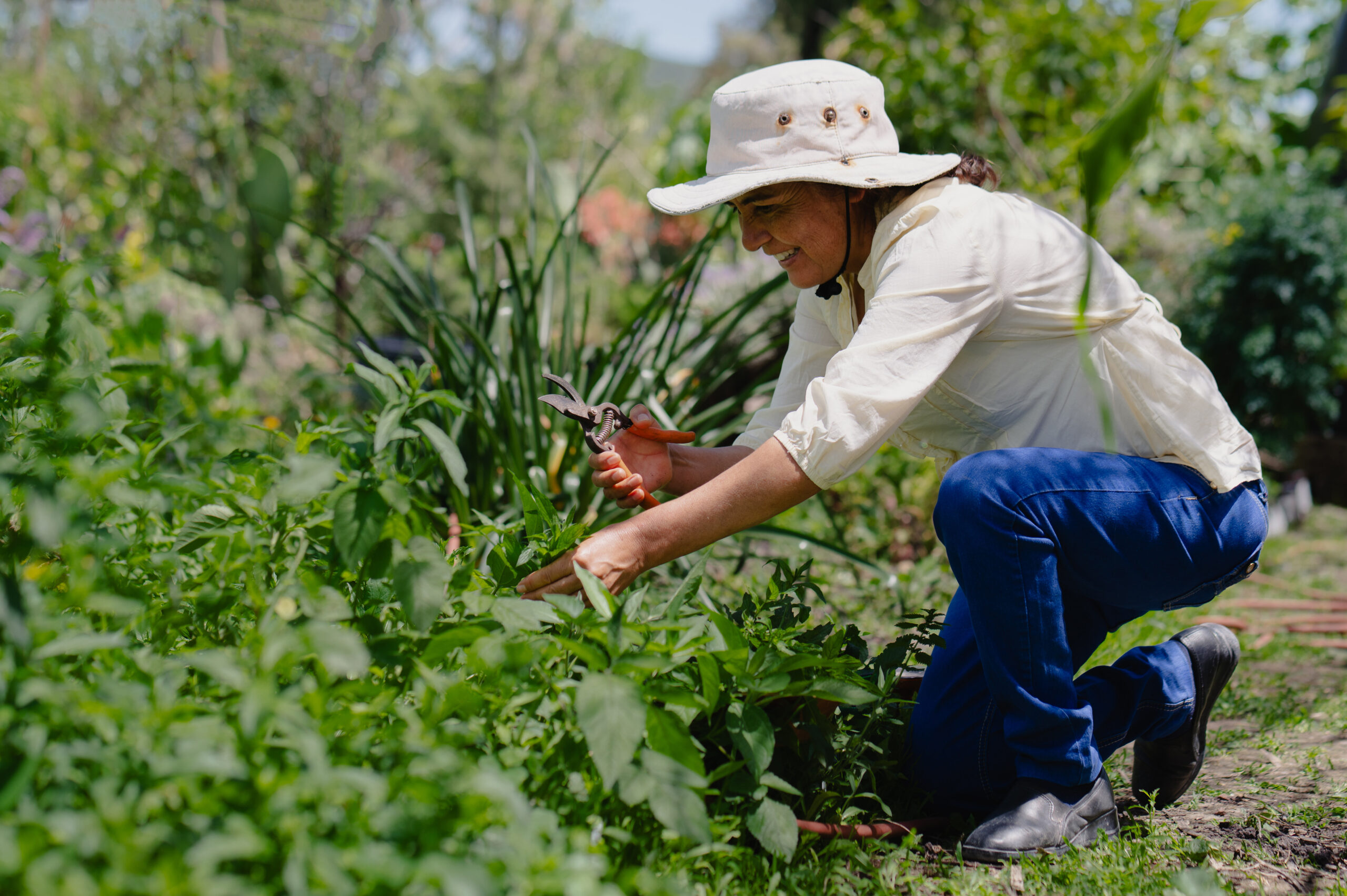
Caption: Salomón Aguilar Hernández Ángeles cosechando en el huerto. La Carbonera, Querétaro, México. Credit: Oscar Maskie
Growth of the project
At present, in addition to arnica, Mujeres y Ambiente exports five species of aromatic plants, which has involved bringing on board and training producers from other states across the country; however, its aim is to continue growing and to involve more producers – particularly women – who, through their work in their gardens, are able to earn extra income for their households, as well as receiving technical and organisational support. The project therefore represents not only a source of income and a means of restoring the land, but also a platform for empowerment that transforms the women’s role within their communities and opens up new opportunities for their development.
Projects of this kind and strategic partnerships such as ‘Women and the Environment’ demonstrate that there are no small initiatives, but rather a willingness to work and a working model that can serve as an example for other projects, producers and organisations.
Bibliografía
Torres-Poot, C., (2024) The effect of arnica cultivation on soil and sustainability in traditional production systems in the La Joya micro-watershed. Master’s thesis in Integrated Watershed Management. Autonomous University of Querétaro. 103 pp.