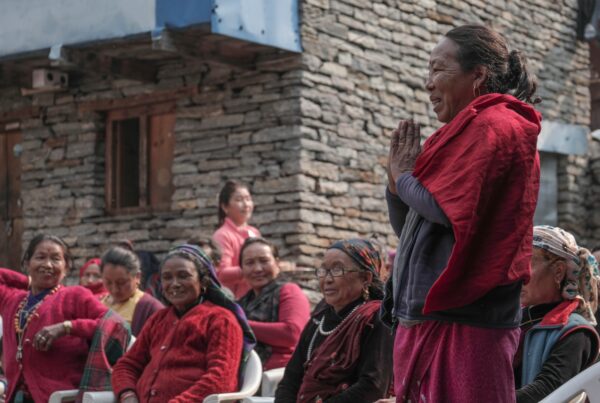

The Stories of My Land project is an Indigenous-led initiative documenting the Tamang community’s resistance to the creation of a hydro-electric transmission line and substation project. In Bojheni, a rural Tamang settlement in Shankharapur municipality in the northeast Kathmandu valley, this infrastructure development is a threat to their land, culture and identity.
In Bojheni, the Indigenous and local communities have a deep relationship with their land; sacred forests, rivers, and hills are not just resources, they are deities and form part of their religious practices. Protecting their traditional land is part of their daily lives.
In 2023, Nepalese authorities began to implement the project, which the community had neither been informed about or consulted on. Nepal Electricity Authorities forcefully initiated a survey of the land and began implementing the project by acquiring community lands through threats and intimidation.
Of course, the community protested. This led to police arresting community members, threatening others at gunpoint, and manhandling women and other protesters, causing injuries to at least a dozen people. The project displaced residents from their houses and the communities faced severe restrictions on both their economic and agricultural activities, affecting both their physical and mental wellbeing.
A recurring sentiment shared by the community members of Lapsiphedi is a lack of care and information about the project. For an established entity such as the Nepal Electricity Authority, this is actually a clear violation of the international guidelines on Free, Prior and Informed Consent (FPIC) of the United Nations Declaration on the Rights of Indigenous Peoples (UNDRIP, 2007) Article 10, Article 19, Article 32 and ILO Convention 169. In a situation where multi-party mediation, proper disclosure, and adequate time for deliberation and community education are both necessary and required by law, the authorities have demonstrated complacency through their neglect of, or aversion to, the human rights of Indigenous Peoples.
Continued community resistance
During an early visit to Bojheni, the Jho Media project team met Sita Maya, a local woman who had been leading the resistance, along with other women, to the project on the ground.
Sita Maya’s involvement as an activist began out of concern for the ecology, public health, and the ancestral significance of the land, and she began to protest against the brazen capture of villagers and the lack of consent from the Tamang community for the project.
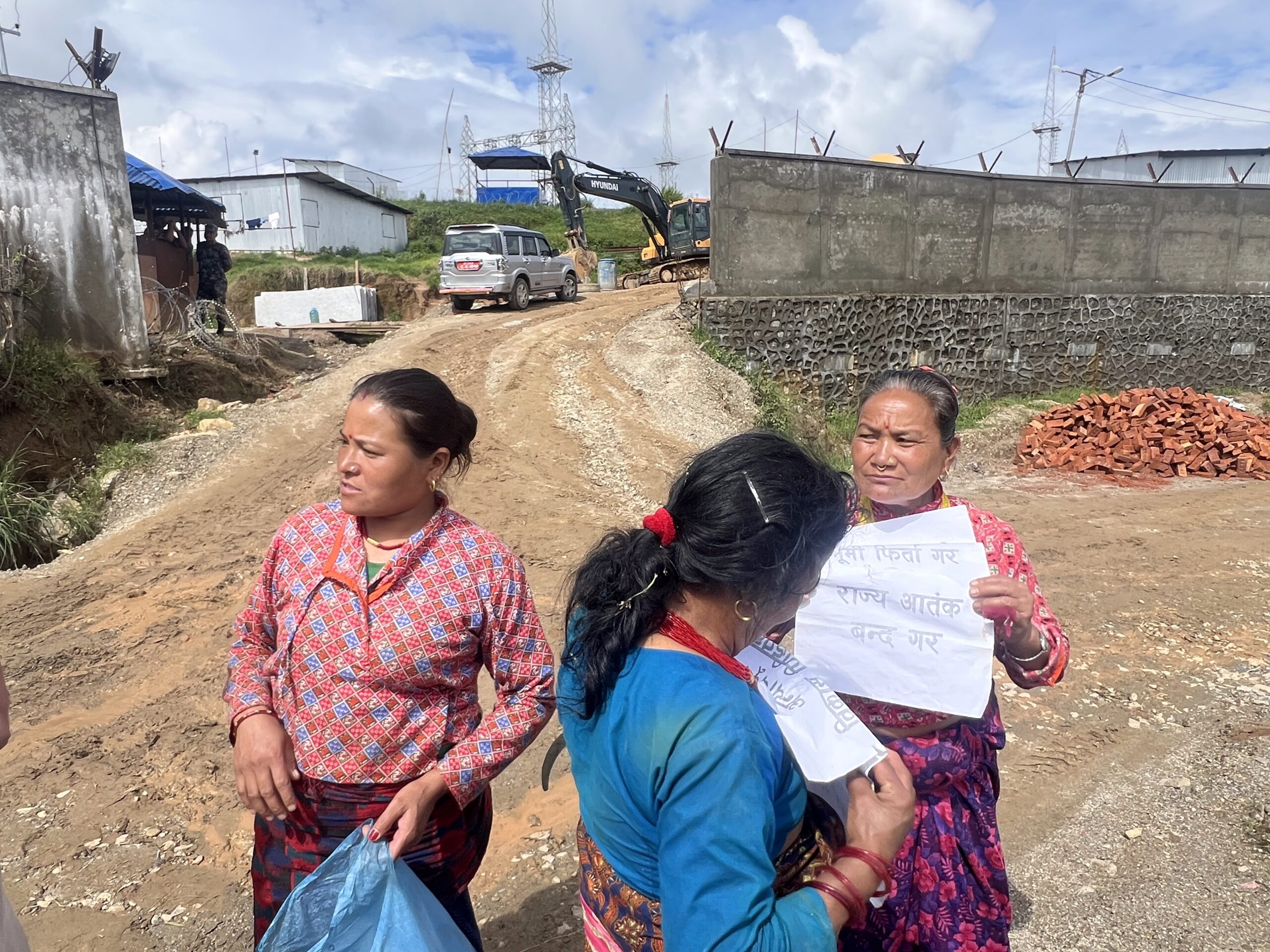
Each day, these women stood in front of a power station, now more than 80% complete, holding placards reading “Protect Our Land” and other urgent appeals. Their resistance includes more than protest: they are preserving oral histories, mapping ancestral territories, and organising community assemblies to assert their land rights.
With little coverage from mainstream media, they turned to independent platforms for support. This led to a partnership with Jho Media, now working to highlight their struggle to a wider audience. These actions are grassroots expressions of the Kunming-Montreal Global Biodiversity Framework (KMGBF) in practice, particularly around Indigenous land rights, knowledge systems, and participatory governance.
Criminalisation of community members
The Nepalese Energy Authority and police have long used psychological intimidation and coercive tactics to dissuade community members from continuing their resistance.
Elderly leader Rita Kumari was involuntarily seized by police from her residence late in the evening and taken to the police station. She recollects that when she contended that she had been taken unjustly, the authorities affirmed that she was at fault.
“Even without fault, they showed how we are at fault,” Kumari said.
The neighbouring Khas and Chettri communities withdrew their protest early on after being approached by authorities and warned of legal consequences, including possible detention, if they did not pause their protest or were found participating in civic demonstrations against the project. The authorities’ warnings were particularly impactful when they stressed the potential loss of financial compensation, consequences for their children’s education and records, and the risk that protest participation could harm future immigration prospects.
When speaking out and mobilising community dissent against the project became dangerous and effectively criminalised, Sita Maya, whose residence stands directly in front of the substation, bore the brunt of the armed repression.
Sita Maya shared her own harrowing experience from 2024, when, after learning that the police were searching for her, she fled and spent a night in the jungle to protect herself and her sister from arrest. The sudden arrivals of armed police in their locality and the erratic escalation of arrests marked a profound shift for her, an individual who had previously lived peacefully in a close-knit community while tending to her household.
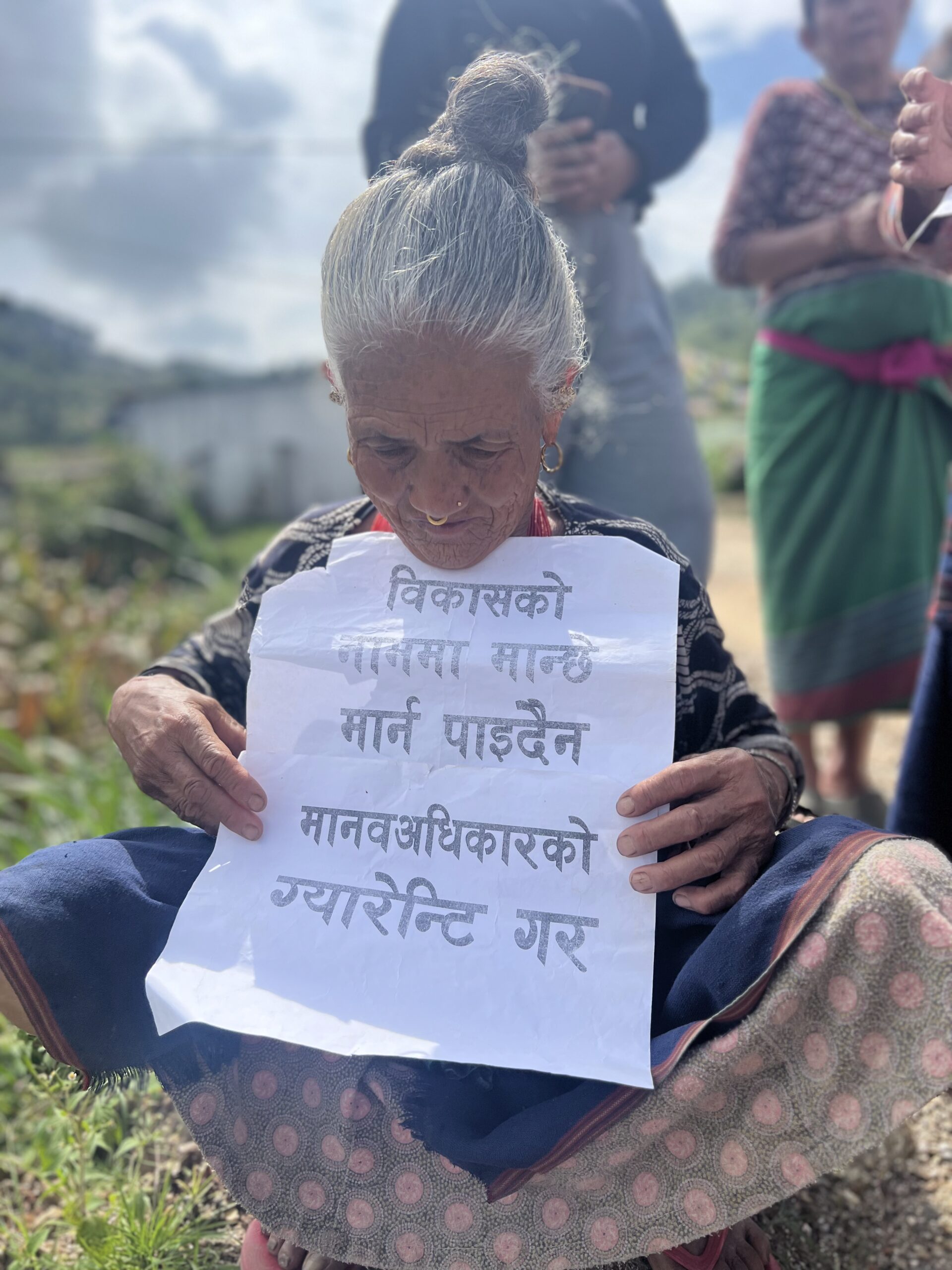
Caption: A community member protests with a sign reading ‘You can’t kill us in the name of development’. Credit: Neha Hirachan
Dismantling collective action
Community members’ concerns were often met not with meaningful mediation or conflict resolution, but with tactics resembling a “carrot and stick” approach designed to dismantle collective action and discourage locals from exercising their rights. Closed-door negotiations, meetings held in forests, and “understandings,” or MOUs, signed without the full participation of community members created deep divisions.
Local leaders, media actors, and even members of families within the community came under pressure to accept compensation, shifting the conversation away from collective rights and toward individual payouts for harm.
The result has been a gradual fracturing of the community: deployed through local intermediaries, the unchecked authority of institutions such as the Nepal Electricity Authority, and the portrayal of activism as a nuisance rather than a legitimate expression of rights. With construction now nearing completion and only two substations remaining, resistance to the project has largely subsided. Yet many residents recognise that their memory of these events may be the only form of power left to them in what they feel has been a losing battle.
Exclusion from participation and decision-making processes
This project is emblematic of how authorities in Nepal are able to override international legal obligations, criminalise Indigenous Peoples and displace them from their ancestral lands for power and political gain.
Despite their leadership and cultural contributions, the Bhojheni community’s resistance remains largely invisible in Nepal’s legal, environmental, and development frameworks. Their customary tenure systems are not formally recognised, and Indigenous perspectives are excluded from decision-making around land use and conservation.
The experience of Bojheni shows that biodiversity cannot be separated from cultural survival. Based on their struggle, the community urgently calls on governments and international bodies to legally recognise Indigenous land governance systems, including Indigenous Peoples, in all biodiversity-related policymaking, and implement legal safeguards against displacement. By elevating the voices of Tamang leaders like Sita Maya, it demands that global commitments to biodiversity must begin by respecting the sacred relationships Indigenous Peoples hold with their land.
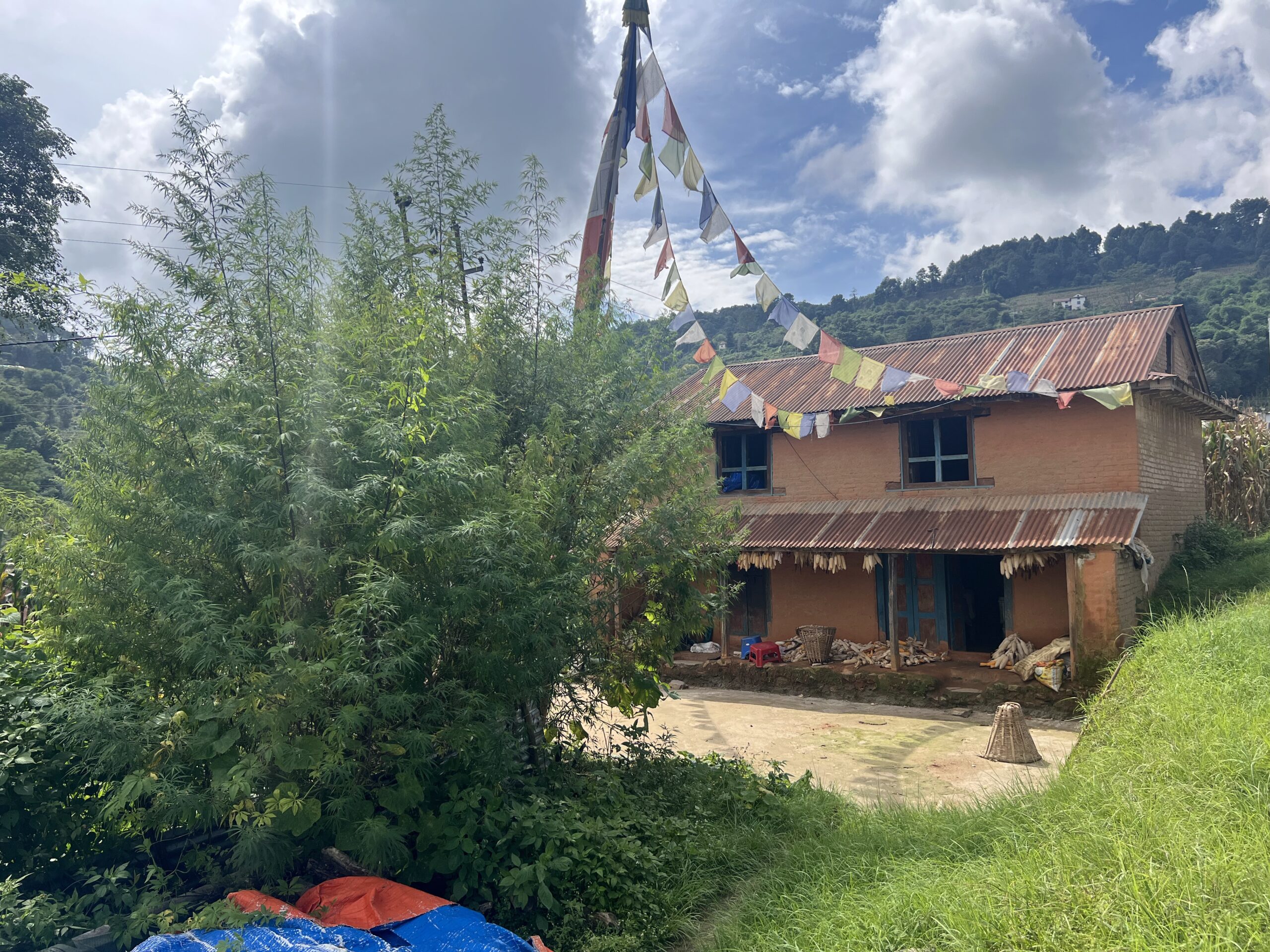
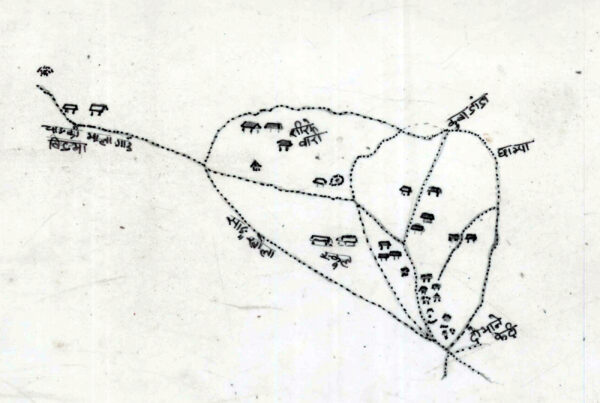
Caption: The community’s ancestral home. Credit: Neha Hirachan
Communal land and erasure of ancestral third space
Before Sita Maya’s house looked out onto a large native turf. The NEA transmission station is built on that turf, a plot Bojheni’s Tamang ancestors separated as their communal third space.
This land was an intentionally cared for green space, built to protect their traditions, customs and the togetherness of their community. A place for rest, play and worship integrated in their daily lives and communal activities. The land served as the village square around which the community members built their houses. And now the same communally protected land has changed. It no longer serves to protect the togetherness of the community. It no longer functions as a place of play for children to grow up in, but it has become a site of betrayal from both the state and community. A site where all the misgivings of the community began.
The hostility during its construction and protest years is forever etched in many people’s memory as the start of Lapsephedi’s fragmentation through displacement, intimidation, and forceful surrender from both an internal and external capacity. Perhaps the fragmentation of the Bojheni community is the biggest loss caused by this “development”.
Ecology disturbances and the easy choice of convenience
When Sita Maya gives us a tour of her village, we see the large, guarded, and fenced substation opposite her house, now visible from almost everywhere in the area. We also notice the dusty environment created by unpaved roads and the constant movement of heavy vehicles. Large black electricity cables lie on the ground awaiting installation, while new transmission tower foundations are emerging between houses and farms. The construction of these tower pads marks the final stage of the project.
She mentions how everything happened so suddenly and how unforeseen the past few years have been, as we walk towards Lapsephedi’s sacred sites and natural water tap (currently not running after project construction) for blessings. Sita Maya points with her index finger to two hilltops beyond and shares the name of a location. “The area past the hills is where they initially planned to construct the substation” she shares.
The Asian Development Bank (ADB)’s project completion and tender report also indicates the change. The Mulpani substation was proposed to be relocated to Lapsiphedi. The revised scope is as follows: (i) Bahrabise–Lapsiphedi (400kV) and (ii) Lapsiphedi–Changunarayan (132kV).(42)
The originally planned site at Mulpani was unviable for construction as it is being rapidly urbanised. The question arrives at the start and how NEA chose Lapsiphedi as a site of convenience and Lapsiphedi’s Indigenous Peoples and ecology as sacrificial lambs without Free, Prior and Informed Consent (FPIC).
References
Asian Development Bank (ADB) (2025). Notice of admissibility on the compliance review: Nepal—Electricity Transmission and Power Transmission Project. Compliance Review Panel. Available at: https://www.adb.org/sites/default/files/Complaint/1079786/NEP-Electricity%20Transmission%20%20Power%20Transmission-NoticeAdmissibility-final_0.pdf
Asian Development Bank (ADB) (2026). Electricity transmission expansion and supply improvement project: Completion report. January 2026. Available at: https://www.adb.org/sites/default/files/project-documents/41155/41155-013-pcr-en.pdf
Focus on Indigenous Girls Nepal (FIG Nepal) (2025). ‘Bojheni substation on Tamang Indigenous land’. Instagram, 20 February. Available at: https://www.instagram.com/p/DGSBnruzBXI/?img_index=3
The Kathmandu Post (2018). ‘Gongor-Khimti transmission line 80pc completed’. 27 May. Available at: https://kathmandupost.com/money/2018/05/27/gongor-khimti-transmission-line-80pc-completed
International Work Group for Indigenous Affairs (IWGIA) and Asia Indigenous Peoples Pact (AIPP) (2023). Statement on state brutality against the Tamang Indigenous Peoples in Nepal. 19 January. Available at: https://iwgia.org/doclink/iwgia-aipp-saman-statement
Singh, P.M. (2023). ‘No light at the end of the tunnel: Substation dispute at Lapsephedi drags on’. The Kathmandu Post, 23 January. Available at: https://kathmandupost.com/national/2023/01/23/no-light-at-the-end-of-the-tunnel-substation-dispute-at-lapsephedi-drags-on
United Nations (2008). United Nations Declaration on the Rights of Indigenous Peoples. March 2008. Available at: https://www.un.org/development/desa/indigenouspeoples/wp-content/uploads/sites/19/2018/11/UNDRIP_E_web.pdf