
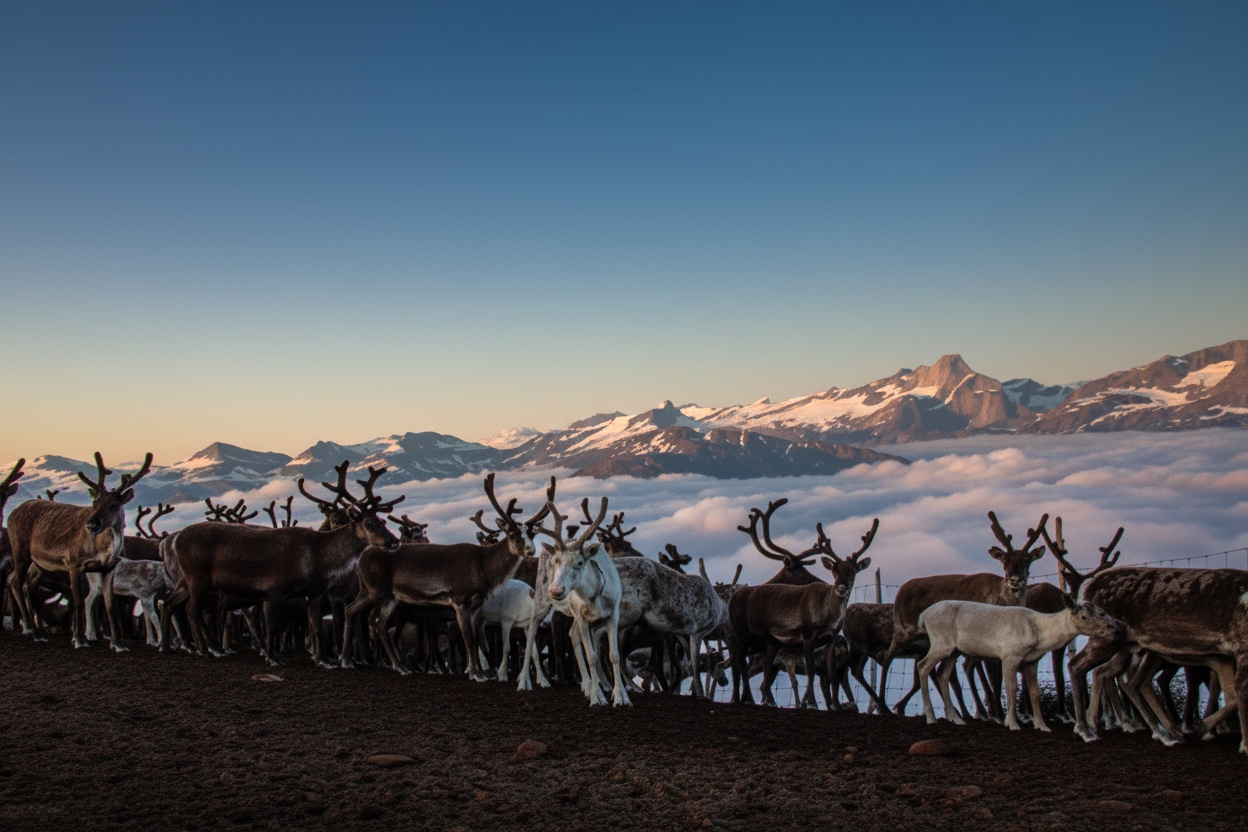

A solitary reindeer bull with imposing antlers and an aura of composed strength is a common motif when artists set about to paint reindeer. This is true, even for Sámi artists, who generally depict their reindeer with large antlers, worn by four- or five-year-old reindeer bulls, known as guosohas and máhka in North Sámi. This iconography of sorts is often used as a shorthand for Sámi culture and identities, as the reindeer bull with its antlers is seen as a proud, powerful, and majestic animal.
To reindeer herders or others with an intimate understanding of reindeer husbandry, however, reindeer bulls play a minor and often subordinate role within an actual reindeer herd. Reindeer herds are primarily made up of reindeer cows, njiŋŋelasat, who function as leaders and organisers of the herd. The most important herd, the áldoeallu, is made up of reindeer cows, and while the luovohasat, the bulls, play an important and integral part in terms of reproduction and herd survival, they are insignificant at best when it comes to establishing herd unity, in a way that supports the herd as a whole.
This understanding of embodied cooperation as a binding contract with nature itself to establish a good life, functions as the very foundation for reindeer herders and others engaged in reindeer husbandry. In short, a reindeer herd teaches us that diversity is fundamental, while highlighting a crucial key lesson: a variety of roles, uses, needs, and power positions is not necessarily to be understood as a succession of gendered dichotomies but rather as a form of gendered complementarity.
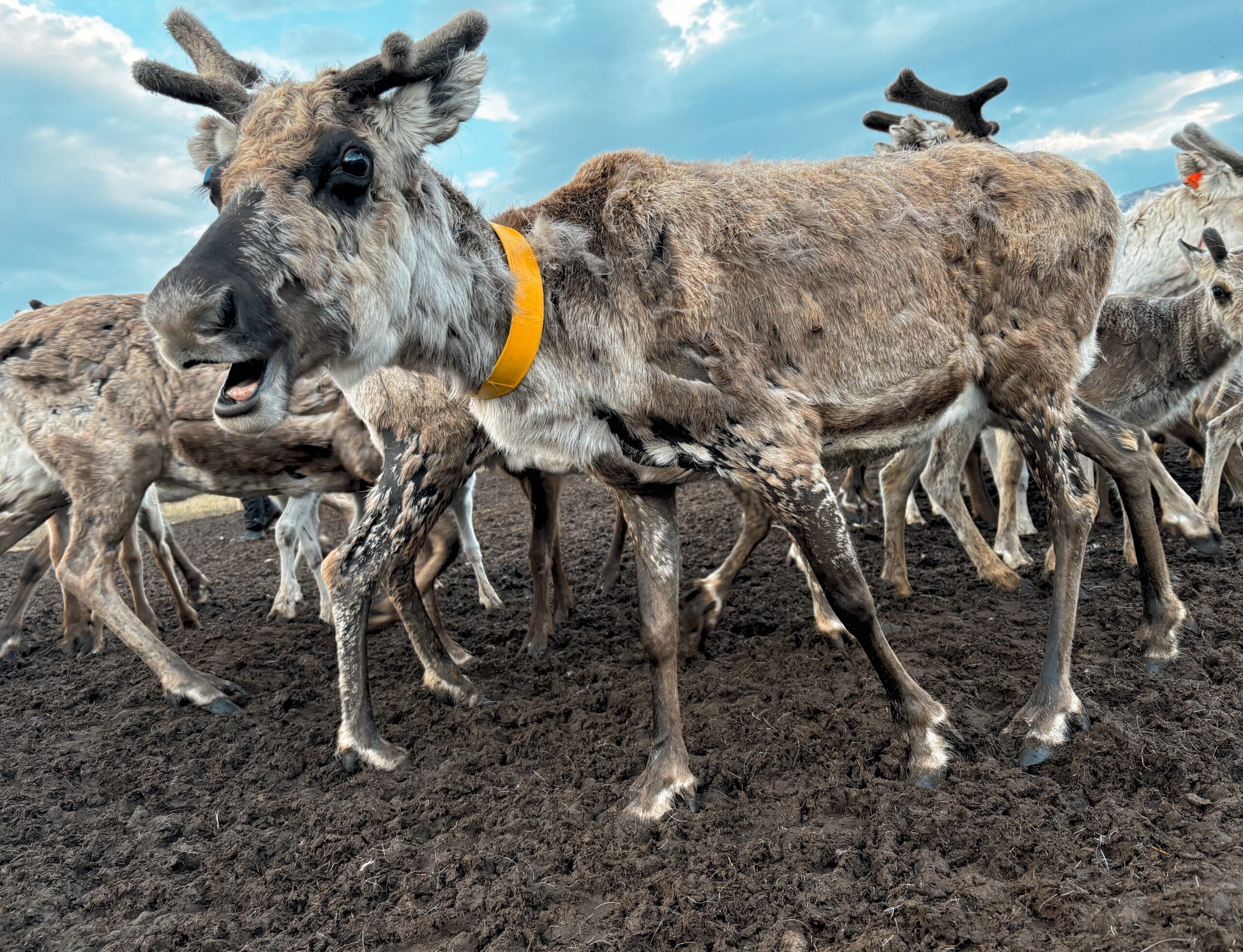
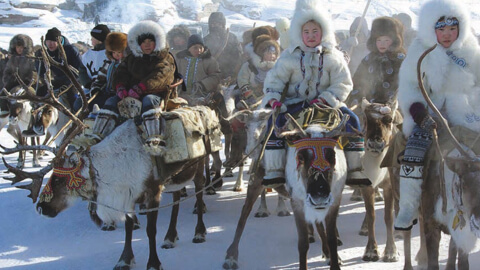
Image: Áldutt, the reindeer cows that determine the herd. Credit: Anne Wuolab
Reindeer husbandry and feminism in Sápmi
I choose to position myself within the reindeer herd from the outset, it becomes the philosophical framework I use to address the field of Indigenous feminism. I draw upon myself as a Sámi woman, based in Sápmi (Nylander, 2022). I come from unbroken Sámi traditions rooted in language, livelihood and traditional knowledge, alongside formal academic training. Indeed, it is this intersectional combination of contexts that I am seeking to address in order to put a spotlight on the field of Indigenous feminism itself and how it relates to sustainable land management (Dankertsen, 2020).
Back to the reindeer herd, and that which is visible and that which is not because it is being ignored by the majority due to a lack of knowledge.
To form a reindeer herd, one needs to balance both business management and self-subsistence, regardless of whether a herder is a woman or a man. Reindeer husbandry is subject to various ever-changing factors, such as access to land and sufficient pastures, weather and climate, the prevalence of predators in an area and one’s own personal interests. For example, do you focus on earning a lot of money from the outset by prioritising meat production, or do you make sure that you and your immediate family have access to food and clothes by using reindeer from your herd.
Whether to focus on personal monetary gains or a more family-focused, communal gain constitutes a fundamental question of sorts, that might even be considered basic or trivial enough to not warrant further or deeper consideration by outsiders, who may have grown up in a more individual-focused society. And if this holds true for reindeer husbandry, then applying the same comparison to address feminism in Sápmi seems apt. Indeed, feminism in Sápmi is grounded in entirely different factors than those recognised by the outside world, but it is becoming more and more obvious that encroachment from the outside world has caused it to change. To further illustrate a Sámi epistemological framework, and what lies beyond its immediate scope, the state-led creation of the Swedish Sámi Reindeer Herding Community, known as a sameby, which heavily regulates reindeer husbandry, serves as a useful example (Labba, 2021). In other words, Sámi reindeer herders are implicitly told that they are only allowed to operate within systems created by a majority society that is not primarily focused on making sure that reindeer herders can succeed or indeed live sustainably from their herds.
The South Sámi author Elsa Laula (1877-1931) addresses the same concerns in her book “Inför lif eller död?” (“Do we face life or death?”) (1904; 2017) when she critiques the deep-rooted prejudice and mistreatment of the Sámi prevalent in the Nordic countries at the beginning of the 20th century.
A careful historical examination of Sámi literature and media reveals that the writing itself, both in content and form, is driven by internal Sámi needs to generate knowledge about themselves, for themselves as well as others. This, in turn, suggests that the intrinsic foundation of Sámi feminism is grounded in explicit resistance to prejudice, structural discrimination and reproductive racism (Svendsen, 2021). Moreover, the aforementioned terms encompass ongoing struggles for rights tied to language and culture in a defined geographical area belonging to the Indigenous People in question. While Sámi in general haven’t left large-scale traces behind, such as houses, the land is still heavily marked by continuous Sámi land use.
Thus, the idea of a Wilderness to be protected as such is flawed, as the continued use and interdependence on the land in question, through Sámi livelihoods, such as reindeer herding, small-scale agriculture, fishing and hunting, have ultimately formed the landscape into what we see in front of us today. In other words, without a Sámi presence, this imagined Wilderness would look vastly different today. Indeed, a Sámi epistemological understanding of the world is based upon the belief that there is no clear distinction between nature and “culture” as such, but rather, these two shape and complement each other. Thus, the idea that nature is primarily a place to conquer, develop or extract resources from goes against the very core foundations of Sámi teachings. Instead, the Sámi derive every part of their culture from an ongoing, reciprocal relationship with the land.
In an episode of the podcast “Samesystrar”, the Sámi scholar Gudrun Kuhmunen discusses the fight she has chosen to take on with regards to securing and maintaining real influence for Sámi reindeer herding communities in the management of the World Heritage Site Lapponia and surrounding areas. Today, this area constitutes one of the few places in Sápmi where Sámi have actual influence on how the land should be managed. However, the area is under constant threat from mining prospectors, who actively threaten to harm both the biodiversity of the area, as well as Sámi ideas of land tenure and self-governance. Kuhmunen takes on this fight on behalf of her community, as well as Sámi reindeer husbandry as a whole, and in this context, her identity as a woman becomes secondary. Indeed, one of the key differences between Western and Sámi feminism is an active focus on collective rights for the community that benefit both women and others, over individual gender-specific rights.
In many ways, what fuses the present time with that of Laula is a shared cause, expressed through similar arguments and through the resistance to marginalisation in matters as fundamental as one’s own livelihood and gender. Once again, it is often these unseen aspects of Sámi culture that become the key to advancing understanding and educating surrounding settler communities.
As a geographical area, Sápmi holds all the resources necessary for societal development and sustainable living, or, to use a North Sámi verb, to birget, across both human and ecological dimensions. Given this, Indigenous feminism in all its complexity and scope becomes vital to sustaining life.
Sámi epistemologies do not maintain a clear distinction between nature and culture in the way that knowledge systems shaped by a Christian social order tend to do. Thus, the right to land ownership, to live in relationship with and from the land, becomes inseparable from the right to be a woman. Or, in sharper terms, to define womanhood, or not, from a Sámi point of view, and to live in accordance with a Sámi definition of Womanhood that may be different from a Western Christian one.
I once read that colonisation manifests as an inherently masculine phenomenon, and there may be truth to this. As a reindeer herder and Sámi woman, I do not automatically draw a straight line between natural strength and masculinity, as my work with the reindeer herd is grounded in an alternative understanding of who is strong and how that strength best serves the collective. Once again, this embodied knowledge remains largely unseen, yet is essential for sustaining life in Sápmi (Wennström, 2021).
Despite this understanding, Sámi women are subject to the same discrimination as any other woman in the Nordic countries today. They face sexualised violence alongside economic and social marginalisation. What I find hardest to comprehend is that women as a gender category (in all its plurality, inclusive of trans and non-binary identities) are still considered subordinate to men. It is here that decolonisation makes visible the destructiveness of social structures that serve to uplift only one group of people. By revealing colonisation to be a heteropatriarchal structure (Kuokkanen, 2019) while connecting it to capitalism as a system, a solitary power structure becomes visible (Knobblock, 2022). What I mean by solitary in this context is a system that is neither collective nor grounded in solidarity. Karin Stenberg, an Ume Sámi activist from the 1920s, describes it as follows:
“The Swede proclaims himself a lover of freedom, and in this, he speaks the truth. He loves his own freedom. Yet he would gladly act as guardian over others. He professes a love of culture and enlightenment. This, too, is true. He loves them only so long as he alone may possess them.”
Karin Stenberg, Dat läh mijen situd! Detta är vår vilja. En vädjan till svenska nationen från samefolket
Terminology
- Guosohas – The name of a four-year-old reindeer bull
- Máhka – The name of a five-year-old reindeer bull
- Njiŋŋelasat – The general name for a female reindeers
- Áldoeallu – The part of the reindeer herd made up of cows and calves, generally speaking the largest part of the herd
- Luovohasat – The name for reindeer bulls that don’t follow the reindeer cows to the calving grounds. They often gather in smaller groups.
References
Dankertsen, A. (2020) ‘Sámi Feminists Moments’, in Nickel, S. and Fehr, A. (eds) In Good Relation: History, Gender, and Kinship in Indigenous Feminisms. University of Manitoba Press, pp. 48–65.
Knobblock, I. (2023) Genusbasert bosättarkolonialism. Gaskauniversiteete.
Kuokkanen, R. (2019) Restructuring Relations: Indigenous Self-determination, Governance and Gender. Oxford University Press.
Labba, E. (2021) ‘Den minst äkta av alla byar jag känner’, in Fjellgren, P. and Nord, M. (eds) Inifrån Sápmi. Vittnesmål från stulet land. Verbalförlaget, pp. 117–123.
Laula, E. (2017) Eallit vai jápmit?: duohtavuođasámit sámiid diliid birra. Inför lif eller död?: sanningsord i de lappska förhållandena. Bágo čálliid siebrie.
Nickel, S. and Fehr, A. (eds) (2020) In Good Relation: History, Gender, and Kinship in Indigenous Feminisms. University of Manitoba Press, pp. 1–10.
Nylander, E.-K. (2022) ‘Ládjogáhpir rematriated: Decolonization of the Sámi women’s hat of pride’, in Valkonen, S., Aikio, Á., Alakorva, S. and Magga, S.-M. (eds) The Sámi World. Routledge, pp. 446–464.
Samesystrar (2023) ‘Gudrun Kuhmunen – om dekolonisering’, Samesystrar [podcast episode]. Edited by Anna Marja Persson.
Stenberg, K. (1920) Dat läh mijen situd! Detta är vår vilja. En vädjan till svenska nationen från samefolket, p. 69.
Svendsen, S. (2021) ‘Sámi women at the threshold of disappearance: Elsa Laula Renberg (1877–1931) and Karin Stenberg’s (1884–1969) challenges to Nordic feminism’, in Keskinen, S., Stoltz, P. and Mulinari, D. (eds) Feminisms in the Nordic Region: Neoliberalism, Nationalism and Decolonial Critique. Palgrave Macmillan, pp. 155–176.
Wennström, A. (2021) ‘Minns mig. Minns att vi överlevde’, in Fjellgren, P. and Nord, M. (eds) Inifrån Sápmi. Vittnesmål från stulet land. Verbalförlaget, pp. 79–87.