
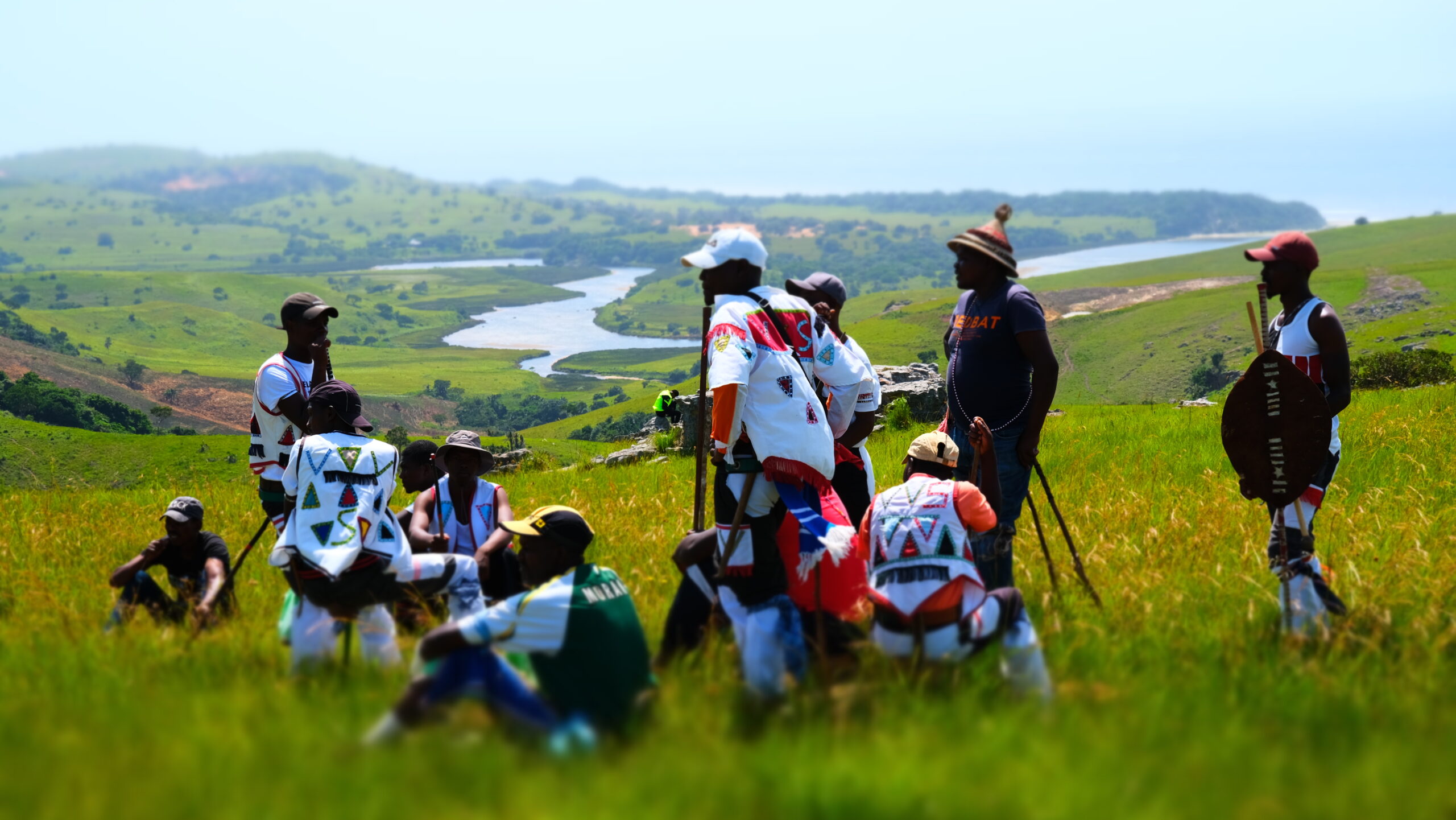

Shimmering waves rush to pristine shores dotted with spectacular waterfalls and wilderness. Amadiba, on South Africa’s Wild Coast in the Eastern Cape, is a land of natural beauty, a land of its Indigenous amaMpondo people, and a place of conservation importance. A number of plant and animal species naturally occur only in this area in the world, because of its unique location and bioclimatic conditions. It is part of the globally recognised Mpondoland Centre of Endemism along the eastern coast of South Africa.
Amadiba is one of the few places in South Africa where the local Indigenous People have remained on their land and retained their way of life and livelihoods. The amaMpondo people continue to grow their traditional crops seasonally, graze their livestock on communally owned land, and live in small homesteads dispersed across a grassland-forest mosaic. Most roads are unpaved, electricity connections are limited, and the nearest city is a few hours’ drive away. Children walk to their local schools, small rooftop solar panels pump river water into gravity tanks, and dedicated local guides take determined tourists on long walks along the unspoilt coast. The community organises annual cultural and food festivals to celebrate their heritage. Amadiba has a blend of tradition and modernity, a spiritual satisfaction in balancing natural abundance and human needs, and it welcomes us all to witness this way of being.
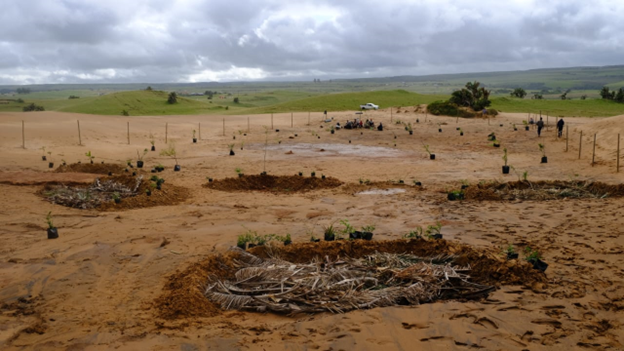
Image: The initiative has revived local knowledge around indigenous plant species and soil management practices such as palm frond mulching, and combines technical knowledge on plant compatibility with soil, wind, animals, etc; in this instance, there is an effort to arrest erosion using suitable indigenous plant species and contouring. Credit: Travis Bailey
Threats to the territory
Yet, all is not as tranquil as it seems – the peaceful coexistence of people with nature is hard won, and is tested time and again. The amaMpondo people have resisted colonist attempts to resettle them, and more recently, have continued to fend off capitalist interests from government and private agencies. Their chosen way of life, shorn of the excesses of industrial society, is a deliberate, intentional path navigated by ancestral knowledge and contemporary aspirations.
The amaMpondo people have been protesting against large scale mining, offshore oil drilling, and super-highway construction on their homeland, efforts which have been recognised and upheld by the national courts. The Amadiba Crisis Committee represents the community in these battles for sovereignty.
“While we resist what we don’t want, we also need to look at what we do want as a community, what we see as sustainable development.”
Siyabonga Ndovela, a youth leader within the local community
Not all threats are outside forces either. Some challenges arise from within. The land in Amadiba is seeing significant degradation due to the compounded effects of abandonment. As more youth leave the region for urban centres, fewer people tend to the pastures. This has allowed invasive alien plants (Acacia, Eucalyptus) and water and wind erosion to severely encroach on the landscape. Traditional soil management regimes, once practiced at scale, are being lost to the collective memory. A strong land care revival is the need of the hour.
This is where Sustaining the Wild Coast (SWC), a non-profit working with the Amadiba, steps in. SWC (Mazibuy’emasisweni in the local isiMpondo language) supports the community through fundraising, partnerships, capacity building, and benefit distribution. Through SWC and in partnership with nonprofit Siyazisiza Trust, the people of Amadiba have secured funding and partnerships to run projects on community ecotourism development, youth capacity building for land custodianship, agroecology, and advocacy work to safeguard and protect the land against unsustainable development.
Co-developed agroforestry initiatives
In the spirit of creating stewardship opportunities for the land and biodiversity, the amaMpondo have also undertaken an indigenous agroforestry initiative. Together with South African NGOs. the Institute for Natural Resources and Siyasisiza Trust, the amaMpondo have co-designed and planted a series of agroforestry sites in their villages, using local indigenous species. These indigenous plant species all have at least one tangible use, bearing edible fruits, medicinal extracts, fodder for animals, or small amounts of wood; in addition, the plants also provide significant ecosystem services like shade, windbreaks, soil stabilisation, and water and carbon sequestration. The project was initiated using funding from the Global Environment Facility as part of the SADC Great Green Wall Initiative implemented by the United Nations Development Programme.
The communities and partner organisations convened in September 2024 to identify priority areas where planting was required. For example, sunny areas in schools were selected for shade tree planting, community gardens for windbreaks, exposed gullies and dunes for soil stabilisation, and so on. This convening also identified local plant species that were desirable for human use (e.g. food, medicine), and also for the aforementioned ecosystem services. The species identification used the amaMpondo communities’ local ecological knowledge, complemented by scientific knowledge from the partner organisations. Many of these indigenous species occur in forests in the steep river valleys in the region but cannot be accessed easily by the communities living in the upper grasslands. In some cases, some of the plant species were prevalent in the grasslands, but had been lost to fire, grazing, invasives, or other such instances. The indigenous agroforestry project aimed to bring these useful plant species closer to spaces inhabited by humans. The spaces and species were matched to site-specific requirements. Plants were procured from various local and regional nurseries and transported to a central site in Amadiba.
Community-led monitoring and future planning
In November 2024, several members of the communities and the partner organisations planted over 2,700 plants belonging to 32 species across 125 hectares of land, as planned through the design exercise. Although care was taken to plant species in places where they could cope with local conditions, it was necessary to measure the success of the planting intervention. To monitor the survival and growth of these plants, some individuals were marked for periodic observation. At three and six months from planting, members of the amaMpondo communities and partner organisations visited these plants and measured their growth. Community members are now familiar with the technique used to measure plant growth and assess its health condition visually. They continue to periodically monitor the plants. There isn’t much quantitative information about survival and growth rates of useful indigenous plants in South Africa, because the forestry and horticulture sectors predominantly use exotic species. Therefore, the data collected by the communities on indigenous plant survival and growth is a very important resource.
At three and six months after the planting, the amaMpondo communities and project partners reconvened to take stock of seasonal changes and exchange learnings. They also discussed the ecological implications of the planting, including visitation by wildlife, expected time to plant maturity, sustainable harvest, and plant propagation techniques. Summer rains had left several places waterlogged, some places overgrown with grass, and many plants in apparent poor health. Winter grazing, fires, and wind erosion had affected some of the plants. However, more plants were visible in the winter than in the summer, and more of them were healthy, indicating they had outgrown the waterlogging and grass crowding.
As of August 2025, the amaMpondo communities have taken full ownership of the agroforestry initiative and continue to care for and monitor the plants. They aspire to propagate these plants and use them in other places in the landscape, including in churches, homesteads, and playgrounds. They would like to test them as replacement alternatives for the invasive alien species that need to be removed. They want to have them in their local nurseries where the community and outside visitors can purchase them. They plan to make delicious jams and jellies when their fruits ripen, to celebrate their reconnection with the plants their ancestors have known and grown alongside.
The success of community-led conservation actions
The indigenous agroforestry initiative is the latest in a long-running tradition of the amaMpondo people in striving for their natural and cultural heritage and food sovereignty. It reinforces intergenerational knowledge transfer, as the indigenous knowledge of AmaMpondo people in Amadiba is being passed on from the elders to the younger people, especially where planting of trees was done in centres of learning. It integrates local ecological knowledge and (western) science, community initiative, and citizen science as a contribution to the ecological infrastructure of the Amadiba region. At scale, it is restoring the landscape by bringing back locally indigenous plant species that were extirpated by invasive alien species and overgrazing. It contributes to diversifying and augmenting the local food system by making indigenous and nutritious food species more readily available.
The amaMpondo people continue to resist erasure by asserting their right to locally led sustainable development. This agroforestry initiative is a key representation of their desired pathway to development. The initiative is a prime example of community forestry, and the preservation and perpetuation of indigenous knowledge. In time, it is bound to contribute to the biodiversity economy, food and nutrition security, and locally devolved resilient and sustainable agriculture. These are government priorities endorsed in policy, and the indigenous agroforestry initiative is a living demonstration of how they can be achieved on the ground. The initiative is fully aligned with the Global Biodiversity Framework goals and targets, as well as the Nationally Determined Contributions towards mitigating climate change.
The amaMpondo people of Amadiba present a united front and a strong voice to claim their right to equitable and sustainable development on their terms. They are responsible stewards of their biocultural heritage, and are determined to negotiate innovative and locally-rooted pathways to conserving it. They are equipped with valuable experience in organising and mobilising for ecological justice and sovereignty. Their agroforestry initiative demonstrates their ability to contribute to local needs as well as national and international commitments on climate and development.