
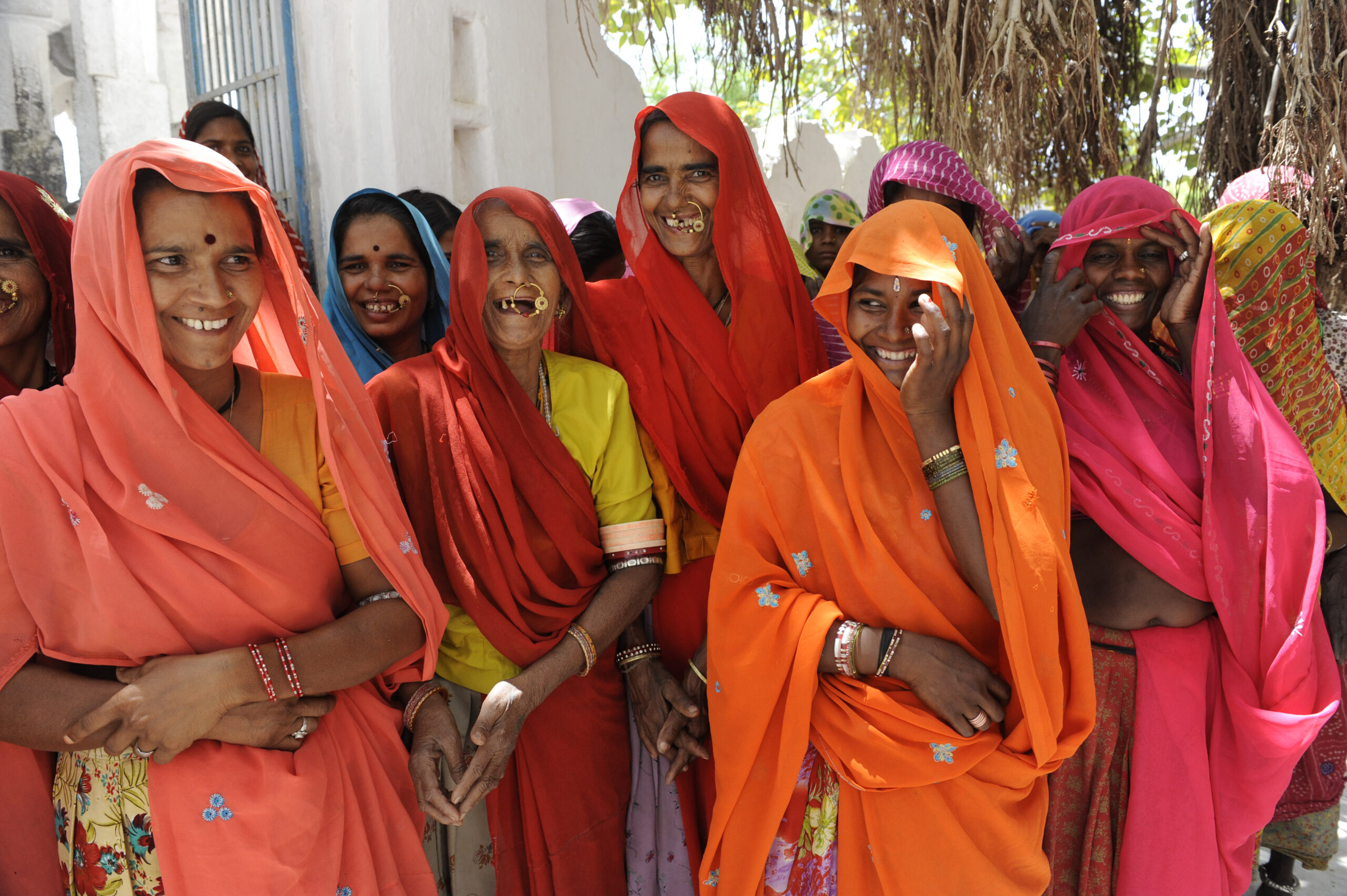

In Udaipur in northwestern India, common forest land is 73% of the total land. Common forest land is a primary source of livelihood and a crucial element in shaping the identity of the local Bhils tribal communities. Tribal customary laws regulate the use of land. As per their custom, village elders control land on behalf of the community and address land disputes.
However, state land and forest laws, policies and reform processes have overlooked tribal peoples’ customary practices and communal land ownership customs. Consequently, conflicts over forests and agricultural land are common, and arise mainly from boundary disputes in shared forest areas and during the collection of nistar (usufruct – the rights of local communities to gather non-timber forest produce and other natural resources) from the commons.
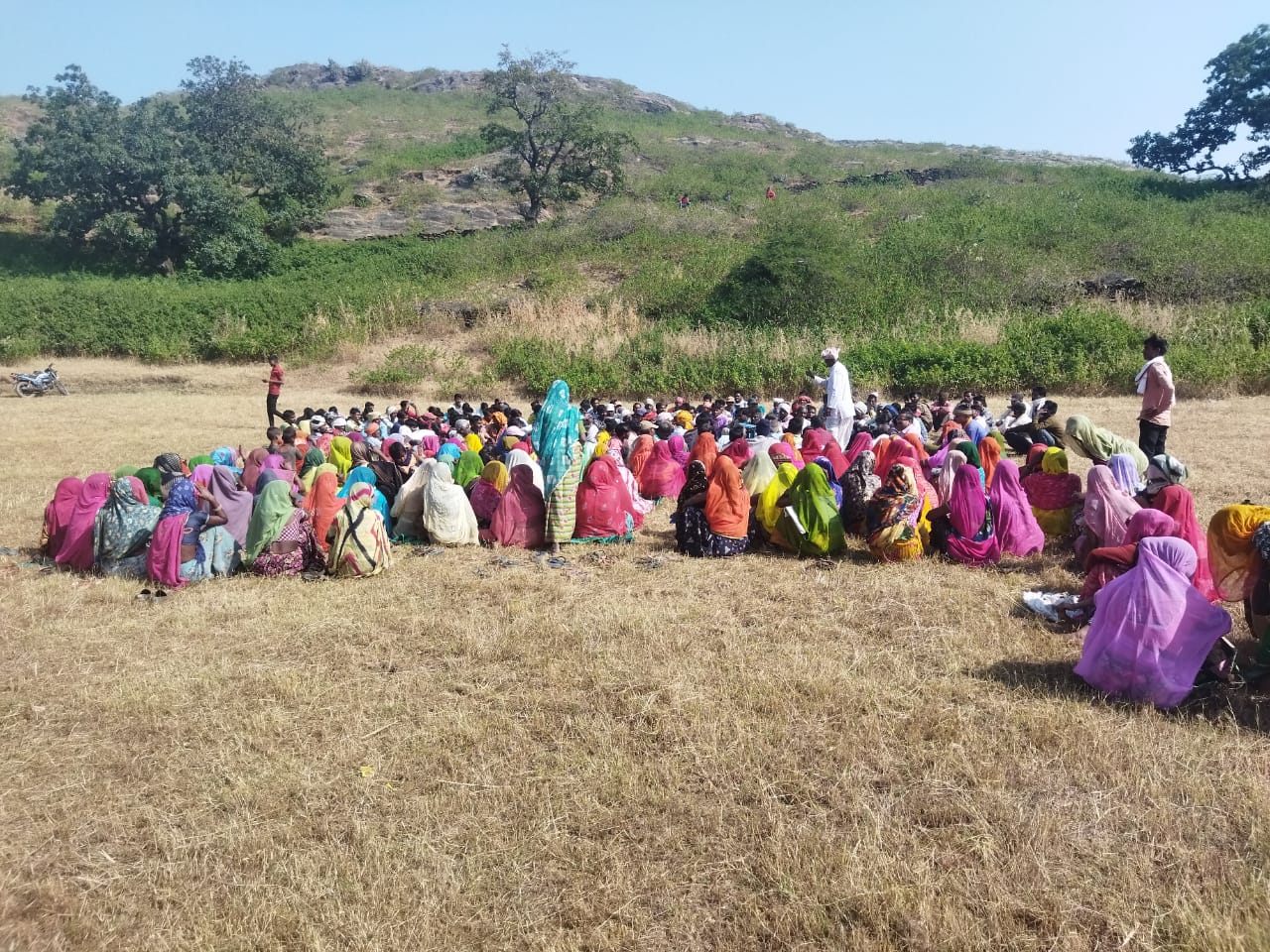
Image: A Gram Sabha meeting (the primary general assembly of a village-level local governing body in the tribal sub-plan)
Key forest laws and policies
National Forest Policy (NFP), 1998 – This policy shifted focus from commercial exploitation of land to environmental conservation and community involvement. Its primary aim is to keep 33% of India’s land under forest cover.
Joint Forest Management (JFM) – Introduced by the NFP in 1988. A policy platform for partnership between local communities, state departments and NGOs to manage forests sustainably and to share benefits, so villagers have the right to continue collecting non-timber forest products and receive a financial share from timber harvesting carried out by the state department. However, in many cases, JFM is practised with scant regard for the customary rights of traditional dwellers, and the policy itself doesn’t recognise these rights. This leads to simmering hostilities among neighbouring villagers over issues of curtailed access, lack of recognition of rights and disputed boundaries.
Village Forest Protection and Management Committees (VFPMCs) – created as part of JFM. Villagers work together to manage the forest. They are responsible for preventing over-grazing, land encroachment and theft of forest products.
Forest Rights Act (FRA), 2006 – Officially known as the Scheduled Tribes and Other Traditional Forest Dwellers Act, it aims to undo historic injustices by recognising the customary rights of Scheduled Tribes and other traditional forest dwellers.
Community Forest Rights (CFR) – Recognises the community’s right to access, collect, use and dispose of minor forest produce, like grazing, fishing and access to bodies of water.
Community Forest Resource Rights – Empowers Gram Sabhas (local legislative bodies) to manage, protect and regenerate community forest resources, and recognises customary rights over collective commons.
Individual Forest Rights (IFR) – Provides land titles to individual/family farmers who have been occupying forest lands for cultivation prior to 2006.
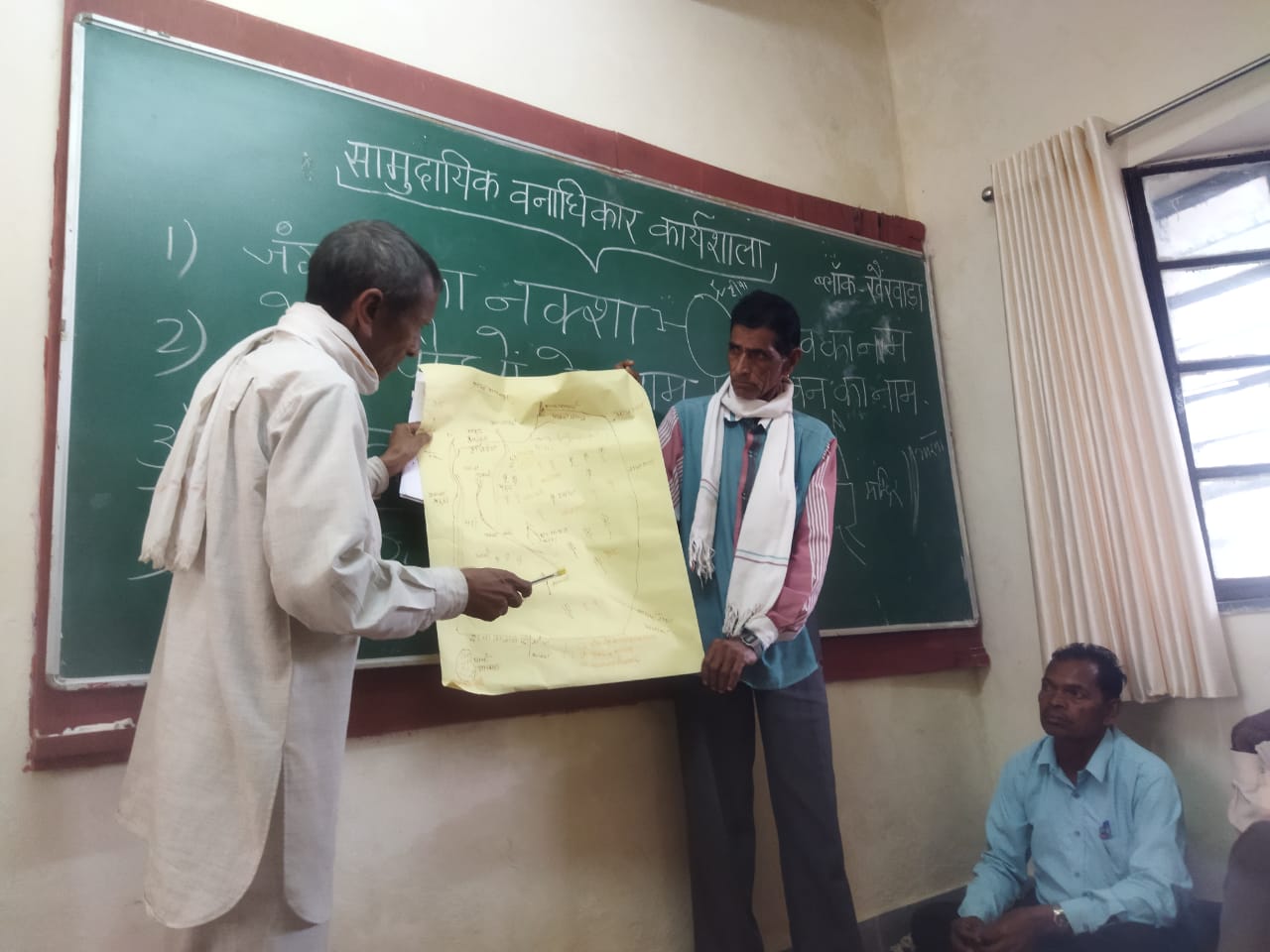
Image: Workshop on the Community Forest Resource (CFR) management plan. Credit: Kirtan Kumar
A community collective: Van Utthan Sansthan (VUS)
Van Utthan Sansthan (VUS) started in 1997 as an informal network of Village Forest Protection and Management Committees (VFPMC), which were constituted under JFM in the region. Since then, VUS has become a federation and an umbrella organisation for community institutions of forest governance, playing a vital role in safeguarding land-based community forest resource (CFR) rights, lands and resources through collective action.
VUS acquired formal status as a registered body in 2003. Its aim is to provide direction and support to village level community institutions to enable conservation and secure tenure on common lands. VUS is managed by volunteers and leaders from villages in the Udaipur area, and also works collaboratively with Seva Mandir, an NGO founded in 1968 dedicated to sustainable resource management, livelihood improvement and strengthening village-level governance.
Case study in Amivada: Satyagraha, a non-violent ‘truth force’
Since 2003, Amivada village in the Phalasia tehsil (subdistrict) has been protecting a 16-hectare pastureland on which they began growing bamboo. Once a degraded, rocky and barren space, it is now a forest of bamboo.
This transformation from barren to green land is the result of 15 years of hard work and sacrifice on the part of the villagers. In 2016, the bamboo became mature for harvest, and the villagers of Amivada sought clarity from the government over who could harvest the bamboo and under whose supervision. No clarifications were received from the government for two years.
The village community in Amivada therefore decided to launch a Satyagraha by harvesting the bamboo. The word ‘Satyagraha’ refers to ‘truth force’: non-violence is an essential part of this methodology. The objective of Satyagraha is justice; it does not hinge on loss or gain, for and against, but all sides coming together for better outcomes.
To express solidarity with the village community of Amivada, 14 other villages took part in this Satyagraha initiative in Badgaon, Khamnor, Kherwara, Rishabhdeo, Jhadol and Girwa tehsils. The respective panchayat (self-governance bodies) at the Amiwada site gave approval with prior consent from the forest & revenue department for the harvesting of bamboo since the communities have been working hard for the development of their village pastures.
On 20 February 2018, a Satyagraha was launched, during which bamboo harvesting was undertaken at the Amiwada site. Prior to the Satyagraha, a press meeting was held where it was announced that if permission for bamboo harvesting was not granted, the community would proceed with the protest. This meeting proved effective, as it led to the Forest Department issuing the required permission letter later that same evening.
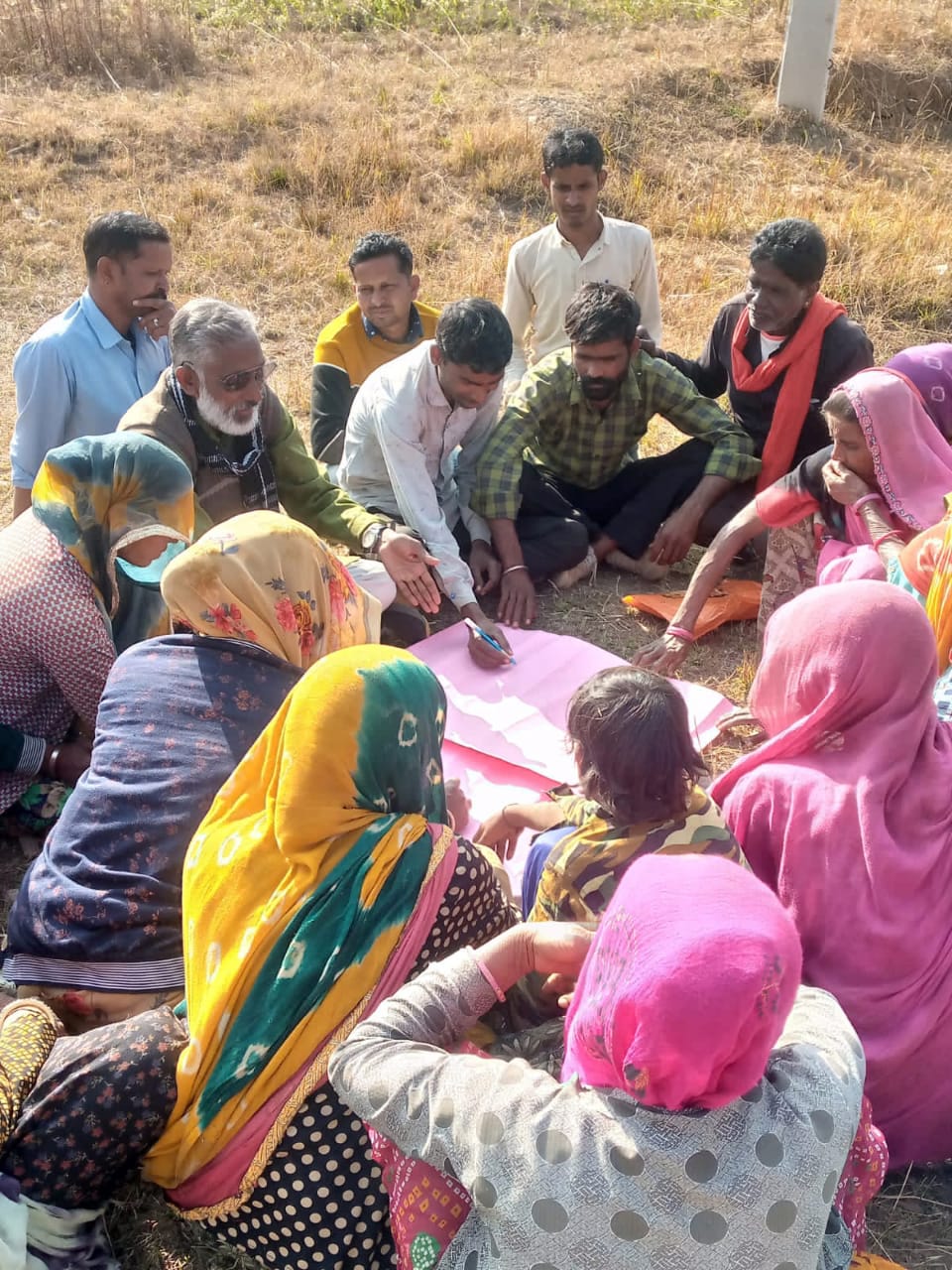
Image: Participatory planning meeting for CFR management plan by Van Uthan Sansthan. Credit: Dr G P S Jhala
VUS and community contributions to biodiversity conservation
VUS has also been instrumental in achieving an increase in livelihood opportunities for communities through facilitating restoration activities (by utilising funds coming for the region through various state agencies, including the forest department) and sustainable harvest of bio-resources from forest areas in the region. This contributes to conservation of native flora & fauna in commons landscape of the area.
Sustainable conservation and restoration of degraded ecosystems
Forest and grassland regeneration in the Aravalli Mountain ecosystem
VUS has worked with community institutions such as VFPMCs and CFR Management Committees to regenerate approximately 71,500 hectares of community forest and around 20,000 hectares of village pastures, with support from Seva Mandir’s afforestation programme. This has been achieved by strengthening grassroots governance of common lands.
VUS functions as a federation of these VFPMCs and CFR Management Committees, where regular dialogues and community meetings are held to plan conservation and management actions, and to ensure equitable access and benefit-sharing from bio-resources harvested from these forest areas.
Restore Aravalli Forest landscapes through community engagement
The initiatives have contributed to the restoration of the tropical dry deciduous forests of the Aravalli Range through community-led efforts and collective action. These efforts have supported the regeneration of native flora and the creation of habitats for local wildlife.
Local communities have played an active role through their institutions, engaging in conservation and management practices rooted in Indigenous knowledge and traditional ecological systems. These community-conserved forests and village pastures, often located in the buffer zones of protected and reserve forests, play a vital role in strengthening biodiversity and maintaining the ecological balance of the landscape.
Supporting wetland ecosystems in the region
The protection and restoration of community forests have indirectly supported downstream ravine and wetland ecosystems. Soil and water conservation measures have been implemented to reduce runoff in drainage channels and on sloping mountain terrain. These interventions have helped improve soil moisture, promote silt deposition, and enhance groundwater recharge in downstream water bodies such as ponds, open wells, natural springs, streams, and ravines.
As a result, these ecosystems provide critical services to downstream agro-ecosystems, contributing to improved soil health and increased farm productivity.
Sustainable use and equitable sharing of resources
Approximately 10,000 tons of grass fodder are harvested annually from village pastures regenerated through support of VUS’s mother organisation, i.e. Seva Mandir. VUS has planned with 44 CFR villages to ensure that harvesting is carried out sustainably and that the benefits are shared equitably among community members. It has also supported the development of grazing management systems and promoted the sustainable harvest of non-timber forest products.
In addition, around 1,500 tons of grass fodder are sustainably harvested from managed CFR sites covering 1,751 hectares—representing a benchmark of 5% of the total CFR area. This harvested fodder is distributed equally among beneficiary households, supporting nearly 7,000 cattle for 60–70 days during lean periods.
Other non-timber forest products, such as Mahua flowers, leaf fodder, pongamia, and jatropha seeds, are also harvested sustainably and shared equitably among beneficiaries.
Invasive species
Prosopis juliflora and Lantana camara are among the most aggressive invasive species in Rajasthan, significantly altering local ecosystems. These species have spread across large areas of community grazing lands, reducing biodiversity and displacing native fodder grasses essential for livestock. In areas invaded by Prosopis juliflora, species diversity has been found to be up to 78% lower compared to non-invaded regions.
VUS has worked with community institutions to build awareness around bio-control measures and promote the sustainable use of these species, such as for fencing. In parallel, local democratic bodies like Gram Panchayats have been sensitised to take resolutions and leverage schemes such as MGNREGA for the manual or mechanical removal of invasive weeds.
Promoting traditional knowledge
Through regular community meetings and dialogue, VUS has worked with local institutions to promote the use, preservation, and recognition of traditional knowledge. Knowledge-keepers and village elders are actively engaged in sharing insights on local ecology and wild flora and fauna, particularly during the preparation of community forest management plans and related documentation.
In addition, jungle treks are organized that bring together elders and children from Seva Mandir-run bridge schools, creating opportunities to identify local plant species and learn about their traditional medicinal and domestic uses.
Strengthening local governance
Strengthening community institutions such as VFPMCs and CFR Management Committees enables effective grassroots governance and conservation of forest commons.
Promoting active participation of these institutions by engaging village members through scheduled Gram Sabha meetings to submit convergence proposals and secure resolutions for the restoration of forest commons under the respective Gram Panchayat.
Through such convergence with Gram Panchayats and financial support from the State Forest Department, approximately 2,187 hectares across 23 CFR forest sites are currently being restored.
Context: the history of VUS
Van Utthan Sansthan (VUS) started in 1997 as an informal network of Village Forest Protection and Management Committees (VFPMC), which were constituted under JFM in the region. Since then, VUS has become a federation and an umbrella organisation for community institutions of forest governance, playing a vital role in safeguarding land-based community forest resource (CFR) rights, lands and resources through collective action.
VUS acquired formal status as a non-governmental organisation on 28th March 2003. It aims to provide direction to the village-level community institutions, such as the Village Forest Protection & Management Committees (VFPMCs), Eco Development Committees (EDCs) in wild line sanctuaries, , and the CFR management committee (CFRMC) to enable conservation and to secure tenure on forest commons. VUS is managed by volunteers and leaders from respective villages.
The General Body of VUS comprises VFPMC and individual members from each of the villages. It democratically elects a seventeen-member executive committee biannually. A management committee of six members includes representatives of the Executive Committee, an office coordinator, and a representative from Seva Mandir, who supports the President, Vice President, Secretary, Assistant Secretary and Treasurer in an advisory capacity. Thirty percent of the Executive Committee membership is allocated for women. The key function of the Executive Committee is to oversee the governance, re-organisation, and re-election of VFPMC and to strengthen other community institutions. Under the guidance of Seva Mandir, VUS develops and implements participatory monitoring, evaluation and research on ecological restoration schemes in the area under Joint Forest Management and customary commons claimed as Community Forest Resource (CFR) under the FRA.
The experienced, highly respected and skilled community leaders provide mentorship and identify opportunities for the further development of new members of the executive committee and identify promising individuals for VUS.
Institutional mechanisms
VUS is a federation of VFPMC and CFR management committees from 110 villages, which elect an executive body. The VUS office coordinator manages the field team comprising 4~5 members who visit the forest villages and conduct community meetings to strengthen grassroots governance for conservation management of community forest resources.
VUS implements its activities through involving Seva Mandir’s field team and community institutions, i.e. Gram Vikas Samuh (Village development committees) established in its operational area of Udaipur, Rajsamand and Salumber districts.
Key impacts
- Established networks of VFPMCs and CFR management committees of 150 villages
- Recognized 297 CFR title under FRA 2006 to Gram sabhas (village council) covering an area of approx. 38,500 hectares
- Formation of the 209 CFR management committee followed by the CFR management plan in 14 sample villages
- Conducting capacity building events on a regular basis for CFR management committees and respective Gram sabhas for CFR governance at grassroots level
- Supported other community organisations and village-based institutions working on implementation of CFR provisions under FRA’2006
- Govt. line department liaising for convergence schemes of restoration community forest in the region
- U.M.L. Environment Award 2002 by Ummaid Mal Lodha Charitable Trust for their commendable work on environmental protection and forest conservation
- Raja Punja award 2010, Maharana Mewar Charitable Foundation, for their outstanding service to tribal people
- Winner of India Biodiversity Award ‘2012 through UNDP & MoEF and climate change.