
The Nahua community of El Pescador is situated on the Gulf of Mexico, in the municipality of Pajapan, in the state of Veracruz. This case study examines the traditional conservation management of the mangroves and the Ostión lagoon within their indigenous territory.
It is situated in the south-east of the state of Veracruz in Mexico, with elevations ranging from 5 to 15 metres above sea level. The terrain is predominantly flat, with some higher areas in the north-west and centre of the community. The lowest-lying part borders Laguna del Ostión.
It has a population of 240 and covers an area of 1,175 hectares; this case study illustrates the traditional management of the indigenous territory of the Nahua Community of El Pescador, in the municipality of Pajapan, Veracruz, Mexico.
It is important to note that the Ostión Lagoon forms part of the territory shared by the 21 communities that make up the indigenous municipality, comprising approximately 1,094 hectares of water and 1,365 hectares of mangroves. The community proposing this case study, El Pescador, has played a significant role as a pioneer in sustainable land management and sustainable management based on Nahua knowledge.
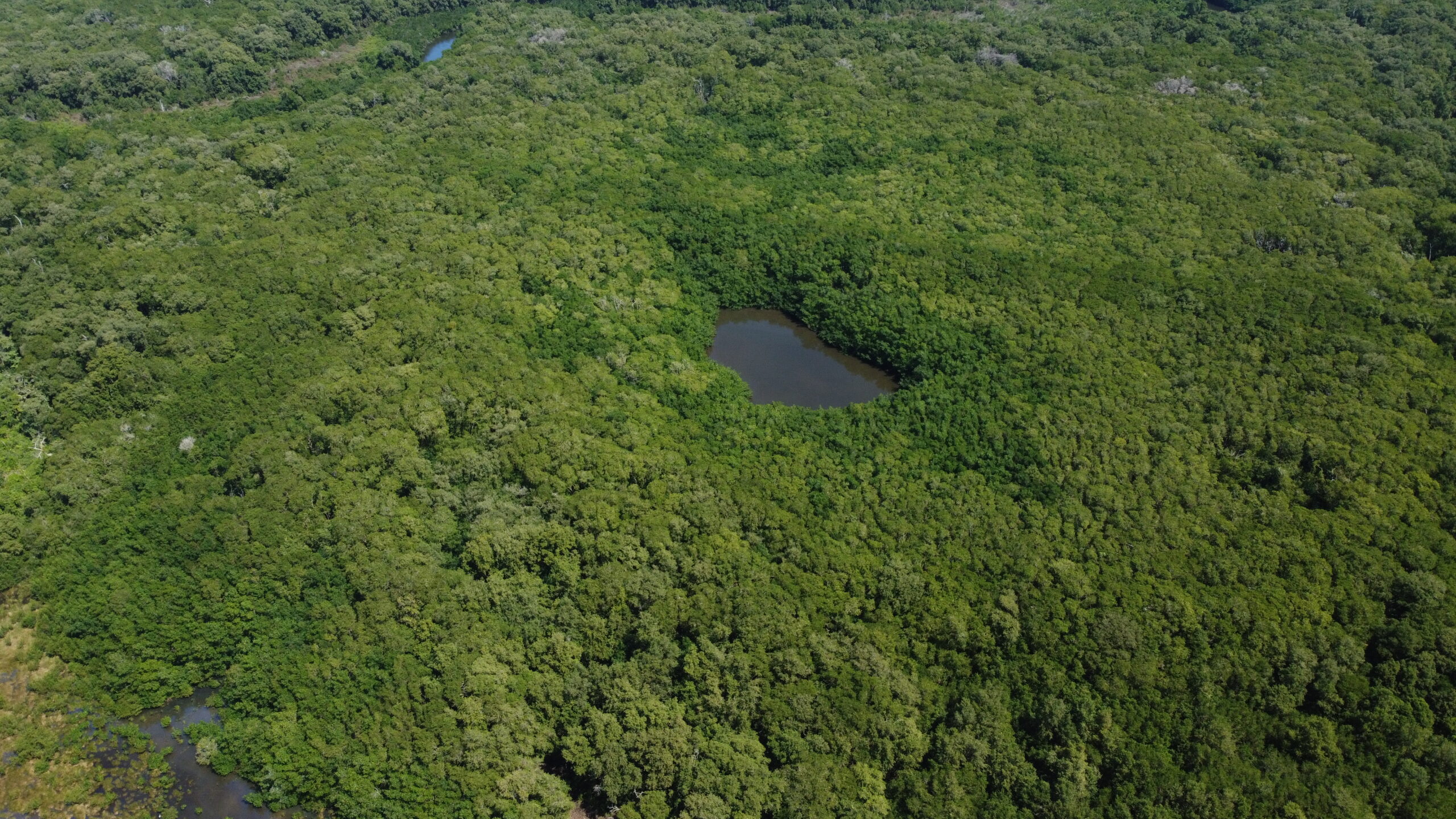
Caption: Área restaurada de manglares comunitarios en El Pescador. Credit: Susana Rocha
El Pescador community
The Nahua identity community manages its entire territory of 1,175 hectares, demonstrating both its deep connection to the land and its biodiverse approach to its management. With a forward-looking vision, it has taken great care to conserve the environment today for the community’s children and grandchildren. This is a commitment to ensure that they can learn about the mangrove forest and the lagoon, and can eat the fish, oysters and clams, apacta (native clam), mullet, chucumite, blue crab, hairy crab – may you enjoy what we currently have.
The community’s way of life has at times led to tensions with the local authorities, who wish to impose their regulations and dictate the community’s way of life and development. However, we are working to safeguard our livelihoods and ensure that the land in Laguna de Ostión is managed in accordance with our traditional customs and practices, as well as the international instruments that protect the rights of indigenous peoples.
The instruments applied are: Articles 1 and 2 of the Political Constitution of the United Mexican States; Article 5 of the Political Constitution of the State of Veracruz; ILO Convention No. 169; the Convention on Biological Diversity (CBD); and the United Nations Declaration on the Rights of Indigenous Peoples.
Land management based on community customs
To ensure a balanced community life, the Nahua community combines strong local organisation with local and inter-community agreements, as well as regulations set out in its internal rules and in its self-determination, customs and traditions, with a view to the sustainability of its indigenous territory.
Community life is governed by its indigenous institutions and traditional authorities, comprising the Commissariat for Communal Property, which is responsible for the management of the territory and natural resources.
It comprises an executive committee (Chair, Secretary and Treasurer); a Supervisory Board (a Chair and two Secretaries); and the Civil Authority, represented by the Municipal Agency, whose delegation ensures the well-being of citizens. The latter is made up of the Municipal Agent, a deputy, a secretary, a commander and a force of seven community police officers responsible for local security. The community is organised around the community assembly, its resolutions and its indigenous institutions, which are integrated into committees.
It should be noted that, although it forms part of the municipal administration of Pajapan, the community determines its territorial activities based on its own customs and traditions and decisions; consequently, the community regulates its decisions through inter-community consultation.
Community life is governed by a set of community regulations covering agricultural, social, economic, productive and environmental matters, within a regulatory framework based on customs and traditions, self-determination and autonomy, which is constantly updated.
The foundation of their environmental achievements lies in their organisational capacity to manage their community and their territory, as shown below:
The management of their territory has enabled them to establish various areas dedicated to land use, productive activities, protection, conservation and respect for the species that maintain the balance of their livelihood.
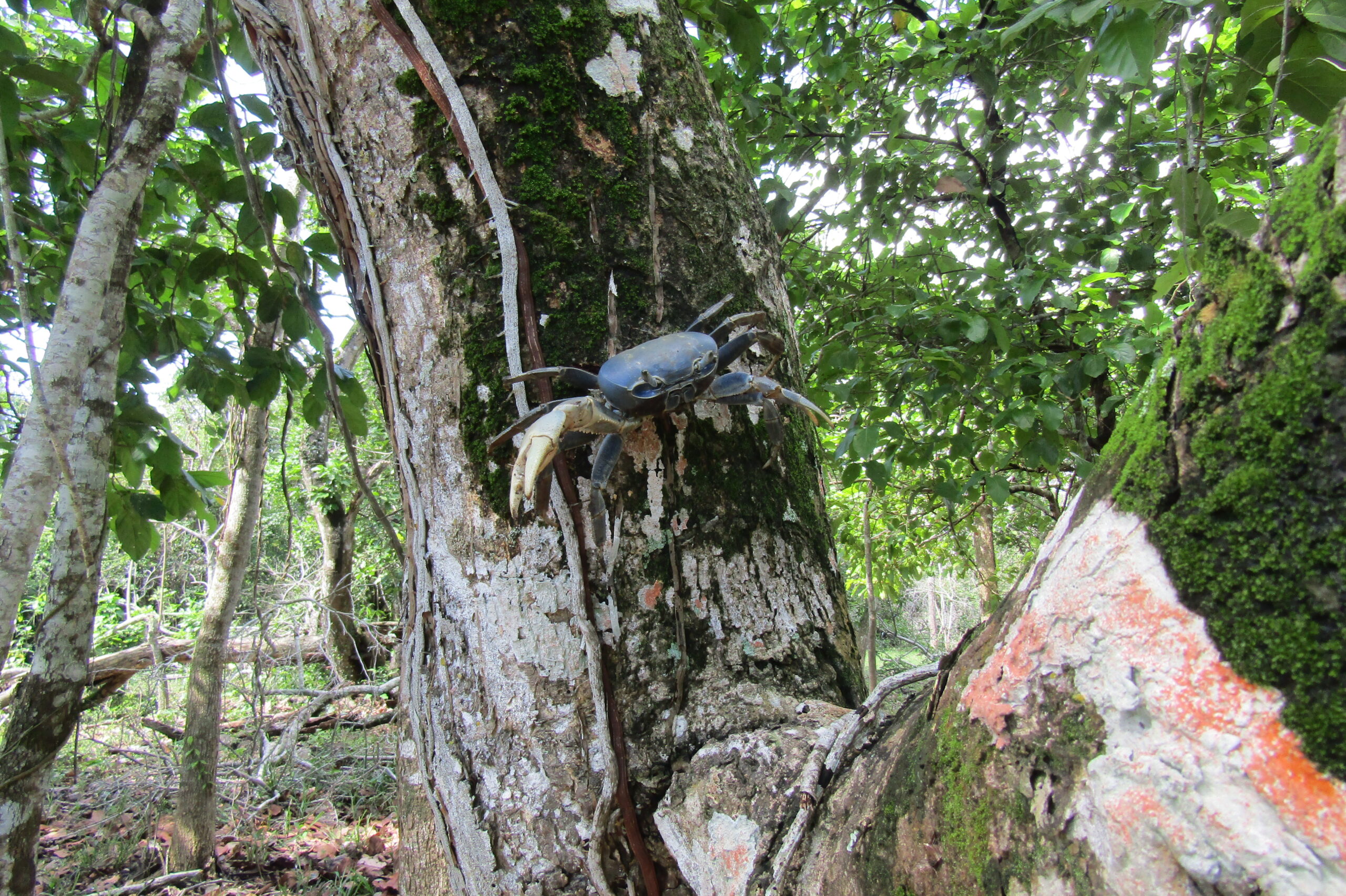
Caption: Cangrejo azul en árbol Cangrejo azul en árbol. Credit: Abril Laura Eloisa Valencia Lara
Sustainable connections and traditional knowledge
Conservation and management practices for biodiversity
Forty years ago, faced with the loss of our vegetation and our natural and cultural environment, we decided to take steps to conserve our oyster lagoon, rivers, mangroves, pools and ditches. We decided to look after the water and the forest. We saw how the clean water from the river was beginning to harm us, as it was becoming polluted by activities in communities further upstream. We also saw that fish stocks were declining in our water bodies, that the river was becoming narrower, that the prawns were fleeing the area, and that once-clean places were becoming littered with plastic and various types of rubbish carried down by the rivers.
As a community, we were concerned because we had grown up in a natural environment where food was plentiful, with vegetation everywhere, plenty to eat, plenty to hunt; there were plenty of fish, plenty of oysters, plenty of venison; there were jaguars, tapirs, mojarra, chucumite and prawns – we had more than enough of everything. We hunted agoutis, raccoons, wild boar, badgers, armadillos, rabbits and iguanas; there was everything in abundance.
The land was tilled by hand using a hoe, machete, spade and pickaxe; no agrochemicals were used. There was an abundance of maize, as well as local ‘ojo de venado’ tomatoes, quelites, chilli peppers, epazote and spring onions – all grown naturally in the region.
Illness was cured with a cup of tea, a rubdown, a blessing or a ritual involving copal, chants and offerings. Fear was cured with prayers and sacred plants. It was common for companions to get lost in the forest because the place had an owner (chaneque or chanée), who looked after it – the lord of the forest. We were connected by a deep respect for our gods, such as Jomxuk (god of maize), and for the guardian of the sea at Punta San Juan, in the sea and the Laguna del Ostión. Our grandfathers and grandmothers passed all this knowledge down to us.
Threats to the territory and the community
However, at a certain point in our history, things changed. Plastics, herbicides, modernity and ‘progress’ arrived. We lost the understanding that ‘the maize cob was not wasted’, that ‘maize seeds were not thrown away unless they were going to be put to good use’, and that a handmade tortilla was not thrown away but eaten in its entirety. No bits were left over and nothing was wasted, because it is our flesh, it is our sustenance, it is what gives us strength.
What followed was a loss of vegetation caused by uncontrolled burning resulting from extensive livestock farming in the region. Fires raged from the lowlands up to San Martín Hill, destroying most of the vegetation in the highland forests of the municipality’s 21 communities.
We called upon our gods and goddesses, our guardians, and the chaneques. We began to lay the foundations, standing firm as a community, expressing our gratitude to the four cardinal points, to the sky and to the earth; they guided us, they advised us, and we listened to their teachings carried on the salty air from the lagoon, from the sea, and from the spiritual essence of the mangrove – our sacred site. We remember who we are, our essence, our memory and the knowledge bequeathed to us by our grandfathers and grandmothers.
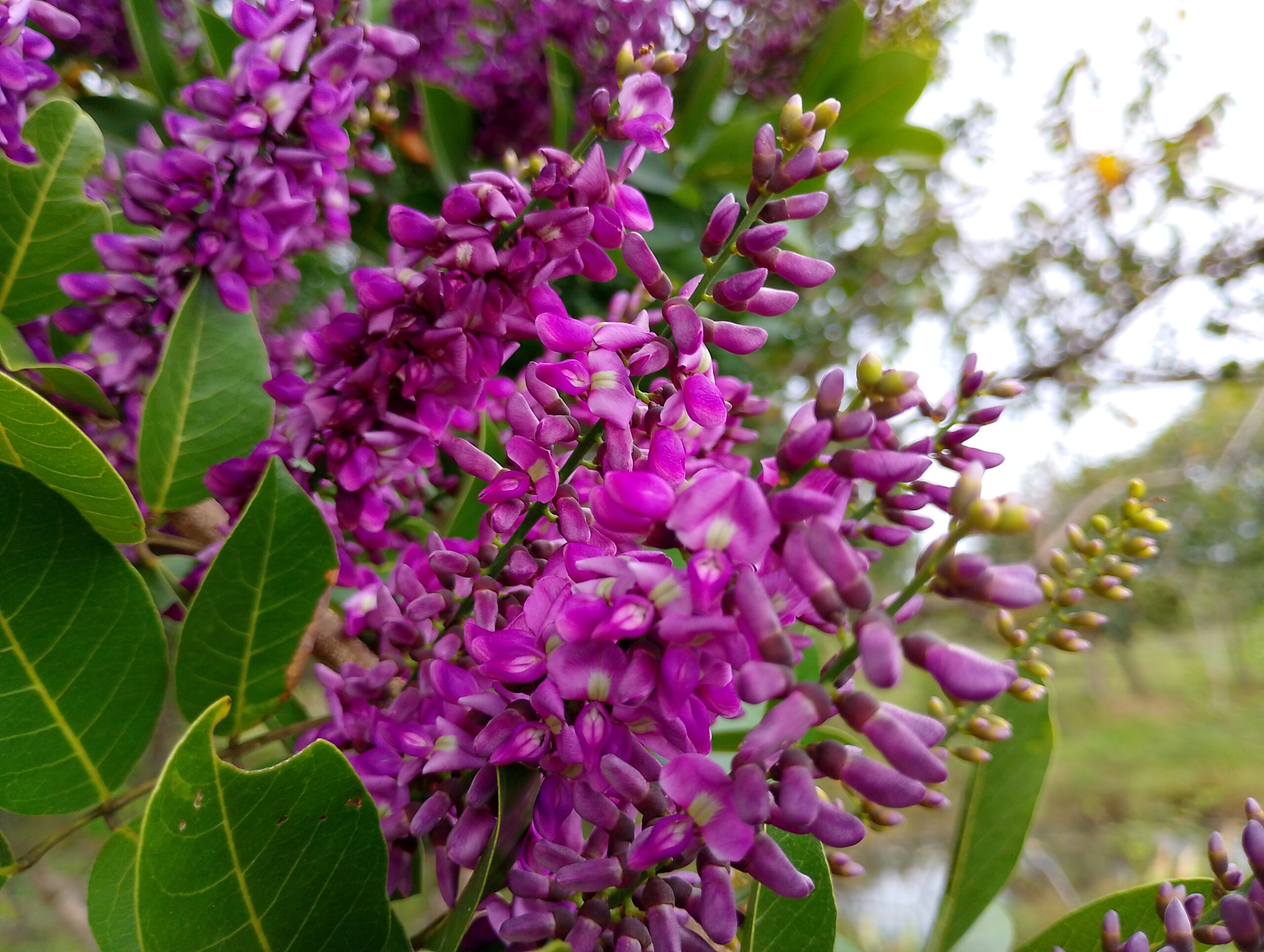
Caption: Floración del Árbol rosa morado, especie de distribución amplia en el territorio de la comunidad su floración es aprovechada por las abejas. Credit: Abril Laura Eloisa Valencia Lara
The community’s response
As the El Pescador community, we established order. We regulated matters through agreements and statutes; the regulations were implemented on the ground. On individual plots, we established an order for our lands, setting out what we could and could not do, designating areas for communal use and areas for individual plots, and defining what could be done within these spaces. We built a community; we fostered development based on Nahua knowledge, on traditional management practices, on management that sustains life, that sustains the water, the sea and the reef. From this foundation, we are building a bridge, creating a difference, and establishing a way of life that is not in decline.
In accordance with the community’s rules and regulations
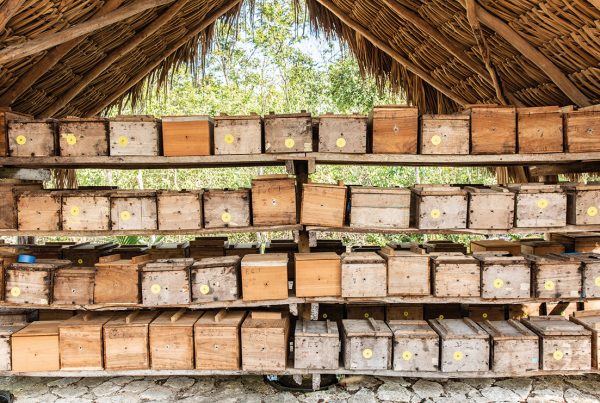
- We started keeping bees to produce honey and preserve the woodland
- We began to focus on looking after the riverbank in strips measuring 200 linear metres by 50 metres inwards on either side of the river
- We built embankments so that the livestock would only affect a 15-metre stretch of the bank per plot, rather than the entire bank
- The use of poison in the river and the lagoon was banned; we were fed up with the fish dying off
- We’ve started fishing sustainably, making sure to leave some for the community’s children and granddaughters, and planning for the future.
From discrimination to collaboration
We invited the neighbouring communities to let them know what we had decided, but they refused to recognise us as a community and blocked our access routes out of the territory. For many years we were discriminated against, looked down upon and confronted simply for looking after our environment. Nevertheless, we organised sit-ins and marches to defend our rights to a healthy environment, and we continue to spread the joy of caring for our surroundings.
Little by little, our ideas took root and bore fruit. Neighbouring communities began to adopt conservation measures and joined a large inter-community alliance known as ‘the 13 communities of the lagoon’. This is a symbolic way of referring to a regional movement aimed at forging agreements that extend beyond a single community. It comprises agreements based on the self-determination of indigenous peoples – agreements concerning life, territory, the care of water and rivers, fire management and crabs; this alliance continues to evolve in line with the dynamics and needs of the communities.
Agreements were also put in place regarding river management, drainage works to reduce flooding, river clearance, and the planting of oyster shells in the oyster lagoon.
Pollution and conservation
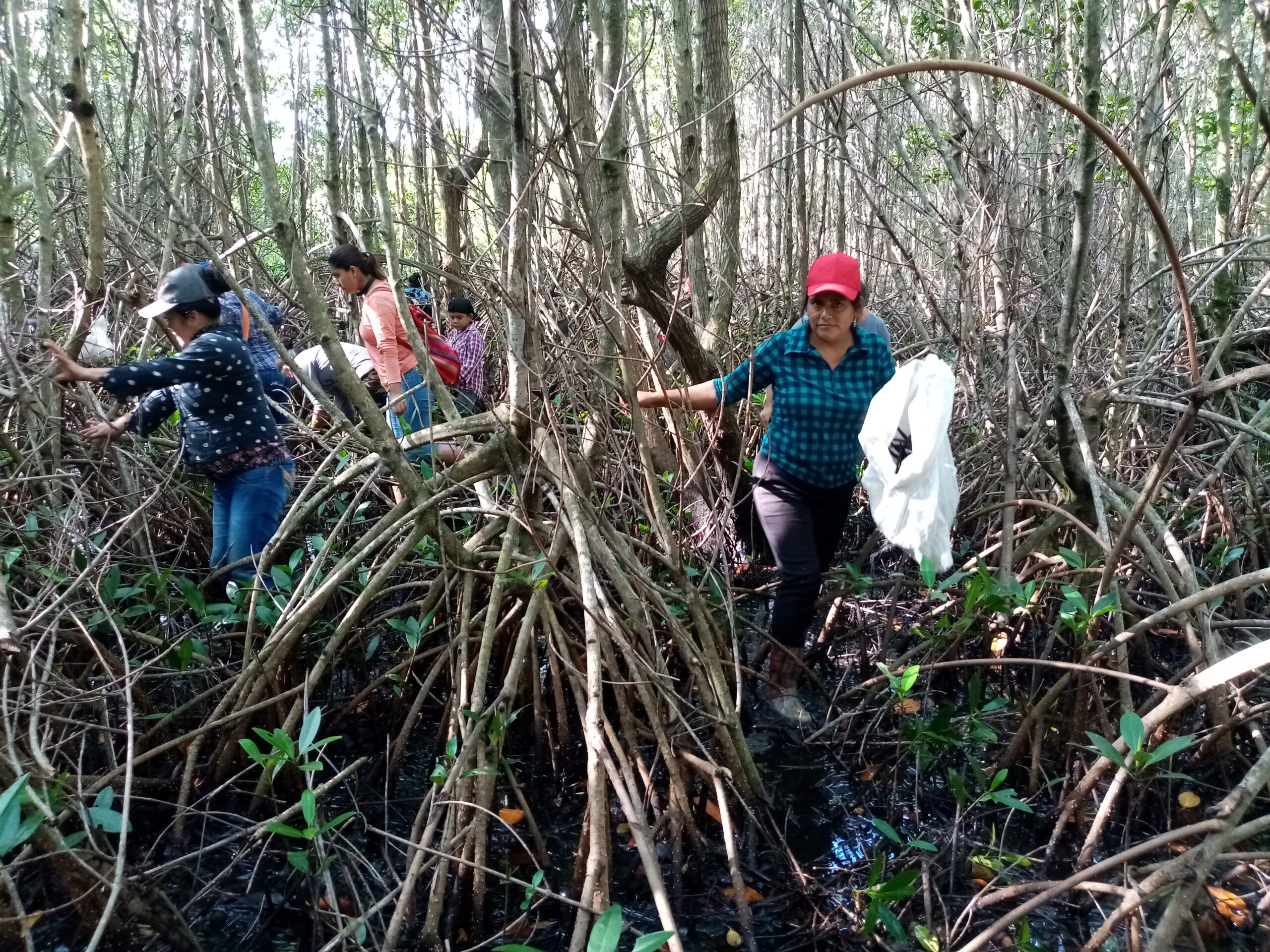
For 40 years, community brigades have been clearing PET (polyethylene terephthalate) and other waste. The community brigades monitor, protect and raise the alarm regarding the felling of mangroves outside the protected area, overfishing, disproportionate catches of blue or hairy crabs, water body poisoning, oil or other pollution, and the capture of crab hatchlings.
Areas for revegetation (acahual) free from clear-cutting and agrochemicals were established, in plots of 4 hectares each. In addition, 128 hectares of communal land were formally designated for mangrove reforestation. We have found that red mangroves are more difficult to establish, so reforestation takes place every year without interruption.
As regards the mangrove forest, we are currently continuing to clear PET plastic from the mangroves and to reforest new mangrove sites, out of the 128 ha that have been successfully restored. We are also carrying out maintenance on drainage systems and ditches that help to mitigate flooding.
New blue crab breeding areas have been established to mitigate over-harvesting by outsiders, which puts pressure on the tegici (crabs). The use of herbicides has been banned in community areas, and clearing is carried out using machetes or tools such as brush cutters.
Empowering the community
We received training in areas we were unfamiliar with; for example, our indigenous rights and environmental issues. We used this knowledge to further develop our community agreements, and we organised our productive activities in line with the characteristics and potential of the land.
We regularly undertake training on our territorial rights and the protection of biodiversity from our indigenous perspective; we are constantly refining our internal regulations. Human rights training sessions have been organised for women and young people, which has led to greater participation in community life and in proposals for land management.
Greater community cohesion has been fostered through the sharing of food amongst all members of the community during the various religious and cultural celebrations. We have also identified that there are two craftspeople in the community: an elderly man who makes handicrafts from coyol leaves – whose creations have a religious purpose – and a woman who weaves baskets and hampers from rushes. However, we have also observed that the use of our language is being lost amongst young people.
We firmly believe in our deep connection with our indigenous territory.
At present, the community is facing pressure from people coming into the area from towns such as Coatzacoalcos and Minatitlán to catch blue crabs. Climate change also caused an unusual flood in December 2025, which inundated the community and affected the apiaries, leaving the residents without their beehives.
Another threat to the area is the plans by the company PEMEX to explore for and extract natural gas using the fracking technique, a move which the 21 communities have spoken out against.
This study strengthens mangrove restoration measures based on the traditional knowledge of indigenous communities such as El Pescador, in Pajapan.
This initiative contributes to the fulfilment of the National Environmental Restoration Programme 2025–2030 (PNRA), which aims for Mexico to restore 5 per cent of the total degraded area of coastal and marine ecosystems by 2025 and 30 per cent by 2030 (primarily mangroves). Our activities are designed to halt biodiversity loss, as set out in the 2030 mission of the Kunming-Montreal Global Biodiversity Framework (MMB-KM).